
Chapter Index
Chart Index


The Mystery Of
Iniquity
Part Three
In Part Two of this study
we sought to show that the gospel currently being preached all over the world
is a counterfeit because it teaches people that they do not have to obey God in order to be saved, but rather, all they
must do is believe in Him. According to most of today’s ministers, salvation is
not based on anything we do. It is based solely on what we believe. They say
salvation is by grace and grace alone. As the result of this perversion,
obedience has been classified as "works" and made optional.
What many fail to realize
is that the Scripture does not teach salvation by grace alone; it teaches salvation by grace, "through faith"
(Eph. 2:8). It also teaches that "faith without works (obedience) is
dead" (James 2:20, 26). In other words, a "workless" or
nonobedient faith cannot save. They also do not understand that optional
obedience can only produce disobedience (lawlessness) in the life of a
Christian—and lawlessness is what the "mystery of iniquity" is all
about.
We also tried to explain what it is we
are to obey. We are to obey the Holy Spirit, who is sent into our lives to show
us the will of God and empower us to fulfil that will. The Spirit is more than
a good feeling, more than a giver of supernatural gifts, more than a
manifestation of power. All these things are but the means to a goal, which is
to fully conform us to the image of Christ. This is the most important thing in
God’s eyes. It takes precedence over evangelism, over Church work or ministry,
over social reform, over everything. The most important thing a believer can do
in this hour is learn to be led by the Spirit on a minute by minute basis.
In addition, we observed
that even though all Christians say
they are being led by the Spirit, clearly, many of them are not, for they are
doing and teaching all kinds of things that cannot possibly originate from a
Holy God. Therefore, one of the most important questions we face in this hour
is: how can we be certain that we are following the right Spirit? We stated
that one way to make sure we are following the right Spirit is through the
knowledge of Scripture, for the Spirit of God will never circumvent the Word of God. The purpose of the Word is
to show us what God is like. It reveals His character, it shows how He deals
with His people, and it reveals the glorious destiny of the body of Christ.
We mentioned some of the
things the Holy Spirit would never
teach us. He would never teach us—either directly or through a minister—that He
wants all Christians to be wealthy, or happy in the flesh. He wouldn’t
teach us it is never His will that we suffer, or get sick, or find ourselves in
need. He would never teach us that doctrine is unimportant, or that the proper
defense of doctrine is wrong, or that Spiritled separation over doctrine is
wrong. He would never teach us that spiritual unity is more important than
allegiance to truth.
He would never teach us
that because we are under the covenant of "grace" we can now sow to
the flesh and reap eternal life. He would never teach us that repentance is not
necessary for salvation. He would never teach us that we will receive rewards
in the kingdom regardless of how we live in this life. He would never teach us
that mental assent to the facts of redemption or the existence of Jesus as the
Savior of the world is enough to save a person. All these ideas—and others far
too numerous to mention—directly contradict the written Word, yet all of them
are being taught throughout the body of Christ by a host of teachers and
preachers today! What’s going on?
And arms shall stand on his part, and they shall pollute the sanctuary of strength, and shall take away the daily sacrifice, and they shall place the abomination that maketh desolate. And such as do wickedly against the covenant shall he corrupt by flatteries: but the people that do know their God shall be strong, and do exploits...And from the time that the daily sacrifice shall be taken away, and the abomination that maketh desolate set up, there shall be a thousand two hundred and ninety days.
Daniel 11:31-32 & 12:11
When ye therefore shall see the abomination of desolation, spoken of by Daniel the prophet, stand in the holy place, (whoso readeth, let him understand:) Then let them which be in Judaea flee into the mountains: Let him which is on the housetop not come down to take any thing out of his house: Neither let him which is in the field return back to take his clothes.
Matthew 24:15-18
Let no man deceive you by any means: for that day shall not come, except there come a falling away first, and that man of sin be revealed, the son of perdition; who opposeth and exalteth himself above all that is called God, or that is worshipped; so that he as God sitteth in the temple of God, shewing himself that he is God.
II. Thessalonians 2:34
What we are witnessing
today is the beginning of the fulfillment of Daniel’s prophesy
concerning the removal of the "daily sacrifice" and the setting up of
the "abomination of desolation" in the Holy Place. This is that which
Jesus and Paul spoke about. Antichrist is taking his seat in the temple of
God—which temple we are. It started with the trashing of sound doctrine in our
seminaries and Bible colleges the last 50 years. Line upon line, error upon
error, Satan has been working through religious leaders to build a doctrinal
"yellow brick road" away from the faith "once delivered to the
saints" (Jude 1:3). Each "brick" of error has had a specific
purpose. Each has been designed to perfectly fit the errors laid down before
it. Each has taken multitudes further and further away from the truth and
prepared them to embrace a counterfeit Christ.
Few Christians understand
what is happening today because, once again, few read what the Scripture actually says. They only read what they
are taught—and what they are taught is (1) the "abomination of
desolation" will be a literal idol, set up in the Holy Place of a literal,
rebuilt temple in Jerusalem; (2) that the "daily sacrifice"
Antichrist "takes away" when he sets his own image up in the temple,
consists of reinstituted Old Testament animal sacrifices; and (3) that this
event cannot possibly happen until 3½ years
after they have been evacuated in the beloved Pretribulation Rapture.
Another thing they are
taught is that being "saved" automatically shields Christians from
any possible spiritual damage. They are assured that being "under the
blood" precludes the possibility of having demon spirits operate in our
lives. The familiar cliché, "a Christian cannot have a demon,"
carries with it the connotation that we cannot even come under the
influence of one. Preachers are loath to admit that evil spirits can still work
in believers and through believers—and even overcome us if we play games with God.
These two errors—that the
abomination of desolation is a strictly literal event, involving a stone idol
and a stone temple 3½ years after the rapture, and also that we cannot be
overcome by evil spirits—serve to insure that most of God’s people will never
perceive what is happening. Indeed, these two "bricks" have put the
majority of believers in such a frame of mind that they are not even capable of
considering the possibility that we are that temple. They wouldn’t
tolerate for a moment the idea that the abomination of desolation is being set
up in the Church. To them this is
absolutely impossible.
Though most Christians
will never consider this possibility, we will consider it in Part Three of this
study, for we believe that an honest examination of the Scripture will show
that what Daniel saw is indeed beginning to happen today among the people of
God!
Brother Daniel
And out of one of
them came forth a little horn, which waxed exceeding great, toward the
south, and toward the east, and toward the pleasant land. And it waxed
great, even to the host of heaven; and it cast down some of the host and of
the stars to the ground, and stamped upon them. Yea, he magnified himself
even to the prince of the host, and by him the daily sacrifice was taken
away, and the place of his sanctuary was cast down. And an host was given
him against the daily sacrifice by reason of transgression, and it cast down
the truth to the ground; and it practised, and prospered. Daniel
8:912
What Is Antichrist?
There is much confusion
over the term Antichrist. When trying to understand exactly what this entity
is, what it will do and when it will do it, we must keep in mind that we are
not dealing with a strictly physical being. We are dealing primarily with a
spirit. Will there be a human Antichrist? Certainly. But we are dealing
primarily with a spirit—and whenever the spiritual
dimension is involved, you cannot approach the biblical data the same way
as if you were dealing with the material dimension alone. Some aspects of
Antichrist and his work are literal and cannot be interpreted spiritually.
Other aspects are spiritual and cannot be interpreted literally. Still other
aspects are both literal and
spiritual. This can be seen in the following example.
And he opened the bottomless pit; and there arose a smoke out of the pit, as the smoke of a great furnace; and the sun and the air were darkened by reason of the smoke of the pit. And there came out of the smoke locusts upon the earth: and unto them was given power, as the scorpions of the earth have power. And it was commanded them that they should not hurt the grass of the earth, neither any green thing, neither any tree; but only those men which have not the seal of God in their foreheads...And they had tails like unto scorpions, and there were stings in their tails: and their power was to hurt men five months. And they had a king over them, which is the angel of the bottomless pit, whose name in the Hebrew tongue is Abaddon, but in the Greek tongue hath his name Apollyon.
Revelation 9:24 & 10-11
And I saw an angel come down from heaven, having the key of the bottomless pit and a great chain in his hand. And he laid hold on the dragon, that old serpent, which is the Devil, and Satan, and bound him a thousand years, and cast him into the bottomless pit, and shut him up, and set a seal upon him, that he should deceive the nations no more, till the thousand years should be fulfilled: and after that he must be loosed a little season.
Revelation 20:13
And they besought him that he would not command them to go out into the deep.
Luke 8:31
The information we have
concerning the bottomless pit shows that it is a place where spiritual
beings are held prisoner. Its first mention in Revelation is in connection
with the freeing of creatures likened unto "locusts." These are not actual
insects, for "they had a king over them" and locusts "have no
king, yet go they forth all of them by bands..." (Prov. 30:27). Also, they
are told not to "hurt the grass of the earth, neither any green thing,
neither any tree." Their scorpionlike tails that inflict pain, along with
their humanlike faces and hair, indicates that they are supernatural, demonic,
intelligent and malevolent. We also see that Satan, who is a spiritual being,
is bound with a chain (which must also be spiritual) and cast into this pit for
a thousand years. Again, when Jesus cast a host of demons out of the Gadarene
they begged Him not to send them into "the deep." The Greek term
there is "abussos" (ab'ussos), the same term that is translated
"bottomless pit" throughout the book of Revelation.
And when they shall have finished their testimony, the beast that ascendeth out of the bottomless pit shall make war against them, and shall overcome them, and kill them.
Revelation 11:7
The beast that thou sawest was, and is not; and shall ascend out of the bottomless pit, and go into perdition: and they that dwell on the earth shall wonder, whose names were not written in the book of life from the foundation of the world, when they behold the beast that was, and is not, and yet is.
Revelation 17:8
Twice the apostle John
said Antichrist (the beast) ascends "out of the bottomless pit." It
should be evident that no human being can ascend out of the bottomless pit. No
nation or oneworld government can ascend out of that pit. No type of religious
organization can ascend out of it. The inhabitants of the bottomless pit are spiritual creatures. The
"beast" that John saw coming out of that pit was a powerful spirit.
At the same time, he also said those who "dwell on the earth shall
wonder...when they behold the beast." If people can "behold" it
with their physical eyes, it has to assume some kind of material form.
And I stood upon the sand of the sea, and saw a beast rise up out of the sea, having seven heads and ten horns, and upon his horns ten crowns, and upon his heads the name of blasphemy...And the ten horns which thou sawest are ten kings, which have received no kingdom as yet; but receive power as kings one hour with the beast. These have one mind, and shall give their power and strength unto the beast.
Revelation 13:1 & 17:12-13
In Revelation eleven the
"beast" is described as an evil spirit coming out of the bottomless
pit. In chapter thirteen it is described as a political power rising up "out of the sea." We know that
in this instance the beast does not represent either a spirit or a man because
John said it had "seven heads" and "ten horns." Later, the
angel explains that the seven heads are "seven mountains." Mountains always represent kingdoms in the
Scripture. He also said the ten horns are "ten kings" who will
"give their power and strength unto the beast" for one hour. In this
instance, the "beast" represents a government. In addition, the
wording of John matches precisely the terms Daniel used to describe the rise of
various world empires—a beast rising up out of the sea (Dan. 7:23). Thus, the
single term "beast" represents both
a spirit and a political government of some kind.
And of the ten horns that were in his head, and of the other which came up, and before whom three fell; even of that horn that had eyes, and a mouth that spake very great things, whose look was more stout than his fellows. I beheld, and the same horn made war with the saints, and prevailed against them; Until the Ancient of days came, and judgment was given to the saints of the most High; and the time came that the saints possessed the kingdom.
Daniel 7:20-22
In Daniel we find details
of Antichrist’s work. Daniel sees a terrible "beast" coming up out of
the sea, on which are ten horns (political leaders). Among these horns another
horn (leader) comes up and overthrows three of them. We know this is occurring
at the end of this age because he
says this horn will make war on the saints and prevail against them until God comes to put a stop to it—at
which point the Kingdom of God is given to the saints. Clearly, the little horn
is a human political leader. Thus, the composite revelation of Scripture shows
that Antichrist—who is called a beast, a little horn and a man of sin—is
manifested in three forms; a powerful spirit, a government and a political
leader. We must understand which aspect
we are dealing with when we try to interpret various individual pieces of the
endtime puzzle. Some very important passages are not talking about a human
Antichrist at all, but about the Antichrist spirit.
The Greek participle
"anti" carries with it two different connotations. It can
mean one who fights against, openly, or it can mean one who fights
against, covertly, by standing in the place of something or posing as
something. The most obvious manifestation of the Antichrist spirit is outside
the Church. It fights against God openly, and is seen in those who are involved
in Satanism or other forms of the occult, such as the New Age movement, the
Masons, the Illuminati, etc. It can also be seen in pseudoChristian cults and
Eastern religions which defame and attack the Person and/or work of Jesus. It
can also be seen in social ideologies such as Communism, Fascism and Socialism,
none of which try to hide their hatred of Christianity and Christians.
The least obvious
manifestation of this spirit is inside the fellowships. It fights against God
covertly, by posing as the Holy Spirit (or angelic messengers), and is seen in
those who are involved in teachings and religious experiences that are directly
opposed to or outside of the restraints
of the written Word. Christians are not being overcome by the Antichrist spirit
outside the churches because the manifestation of that spirit, both in doctrine
and in deed, is too obvious. However, they are
being overcome by the Antichrist spirit inside the churches because it
masquerades as the Spirit of God. This should not come as a shock to us because
Jesus Himself warned that false Christs
would come with such powerful deceptions that all who are exposed to them will
be deceived—all except the "very elect" that is.
Then if any man shall say unto you, Lo, here is Christ, or there; believe it not. For there shall arise false Christs, and false prophets, and shall shew great signs and wonders; insomuch that, if it were possible, they shall deceive the very elect. Behold, I have told you before. Wherefore if they shall say unto you, Behold, he is in the desert; go not forth: behold, he is in the secret chambers; believe it not. For as the lightning cometh out of the east, and shineth even unto the west; so shall also the coming of the Son of man be.
Matthew 24:23-27
When we read that false
"Christs" will appear and show great signs and wonders we tend to
think of people, we think of false prophets. But Jesus said there will be false
prophets and false Christs. The term
false prophets is indeed a reference to individuals, but the term false Christs
has a much wider application. It can refer to individuals who claim to actually
be Jesus, but it can also refer to a false
anointing. Religious kooks like Rev. Sun Myung Moon and David Koresh, who
claimed to actually be Jesus, will never deceive a genuine believer regardless
of how many wonders they produce. But manifestations and revelations that
proceed from the spirit realm and affect us directly, which we are prone to
assume is the Holy Spirit, can and do deceive true believers.
The Greek term "christos"
(khristos')—from which we get the English word Christ—simply means
"anointed." It comes from the Greek rootword "chrio"
(khree'o), which means "to smear or rub with oil; by implication, to
consecrate to an office or religious service." In other words, Christ is
not the last name of Jesus; it is a description
of Him and His office.
The name Christ Jesus
means Anointed Savior. Sometimes the Scripture uses the term Christ as a
synonym of Jesus. Other times it uses the term to call our attention to the
fact that Jesus is "the Christ" (anointed) of God (See: Matt. 16:16
& 20, 26:63; Luke 3:15; John 1:25;
Acts 2:37). Matthew said Jesus was "called Christ" (Matt.
27:22), therefore we have become accustomed to thinking of this term only as a
synonym of His Person instead of His office
as the anointed One. Consequently, when we read that "false Christs"
will come we automatically think of people. But the term can also be a
reference to the anointing itself. In this regard, the issue is not so much who
is coming but what kind of anointing is on him. Many will come in Jesus’ name saying they are anointed
(Christ).
Think about it. Why do
people run after false prophets in the first place? They run after them because
of the anointing they perceive to be on them. They are seeking to hear the
voice of God or feel the power of God through
those who are (or who claim to be) anointed. Jesus’ warning has to do primarily
with what will transpire at the end of this age. He is warning us that in the
last days—which is our day—men who possess real
supernatural power will enter the fellowships and say, "I am Christ"
(anointed). They will say, I am anointed by God to preach and prophesy; I am
anointed to receive and transmit revelations; I am anointed to perform
miracles. Their deception will be overpowering because they will speak all the
right words and do signs and wonders which will look and feel exactly like the
real thing.
Jesus said, "if any
man shall say unto you, Lo, here is Christ, or there; believe it not. If they
shall say unto you, behold, he is in the desert; go not forth: behold, he is in
the secret chambers; believe it not." Of course, the context of that
statement was His literal return in glory. He is telling us that this great
deception will be happening just prior to His return, and that His return will
not be a secret. He will be revealed in glory, in the clouds, for all to see.
But there is a secondary meaning to
His words. He is also telling those who are alive in the last days not to run
after power, gifts, ministries or physical supernatural experiences. Neither
should we be running after "anointed ones." For, in our day, Satan
will be able to produce exact
counterfeits of all these things.
This is no joke friends.
The deceptions of the last days will be a different
class of deception. Those under this false Christ will look exactly like Pentecostals, exactly like Evangelicals, exactly like Charismatics. They will be
moving among the sheep, know all the right lingo, and most likely be in
positions of authority. There is only one thing Satan will never be able to
counterfeit—the nature of God. Therefore, in this hour it is not safe to pursue spiritual power,
spiritual gifts and ministry, "deep" revelations, revival, or social
change. The only safe thing to pursue is the nature of God. If the Lord chooses
to give us gifts, or power, or revelations, or a ministry in the process,
that’s fine. We should not reject them. But anybody who goes chasing
after power, gifts or the anointing in this
hour will end up in deception. Unfortunately, most Christians cannot see this
truth. Even worse, they are too proud to listen to those who can see it.
Add to this situation the
arrogance of those who teach that
Christians cannot be affected, influenced or overcome by demon spirits—an idea
that is not only unscriptural, but is a denial of both present and historical
realities—and you’ve got a monumental spiritual disaster just waiting to
happen! Wherever you find God moving in
the realm of the supernatural among His people, you will always find Satan
moving there as well. This is why, as you study the history of great spiritual
outpourings such as Azuza Street, you will always find excesses. There are
always demonic manifestations right
alongside the true manifestations of the Spirit. In fact, many of the bizarre
manifestations we see happening today were present at Azuza Street as well, but
they were not the norm. The majority
of those who participated in that outpouring reacted in a Godly way. They
repented, they wept, they spoke in tongues, and they began to move in the gifts
and ministries laid out in Scripture.
Ministers who teach that
evil spirits cannot affect or influence us once we are saved are actually
Satan’s most useful tools in this hour. This despicable lie causes the
sheep to assume that all supernatural
manifestations they experience in church must be coming from the Holy Spirit.
After a while it becomes unthinkable to them that God would allow a demon to
manifest itself around them or through them when they have come to
church to worship Him. Since they walk in this erroneous presumption, they
refuse to "test the spirits to see whether they are from God" (I.
John 4:1) and can’t tell the difference between a manifestation of the Holy
Spirit and a manifestation of the Antichrist spirit!
People need to realize
that there is a major difference between Azuza Street and today’s socalled
revivals. In 1905 God’s people were under the heavy influence of "holiness
preachers" who emphasized the biblical concepts of selfsacrifice and
selfdenial, of choosing God’s will at all times and in all circumstances,
regardless of the pain involved, and of righteous living. This kind of
preaching and teaching prepared the
people to safely enter the supernatural realm when God began to move. By
the 1970s, holiness preaching was a joke to most Christians. The concepts of
selfsacrifice and selfdenial, obedience at all costs and holy living had been
abandoned—at least implicitly if not
explicitly—for a more relevant (ie., less oldfashioned) kind of religious
expression. Add to this that a false Jesus, who is a combination of Santa Claus
and Grandpa, was beginning to replace the Jesus of Scripture on a large scale
and what you had was a situation where true spirituality was at an
alltime low.
Enter the
Hollywoodemulating, MegaChurch movement, the Brownsville revival and the Vineyard/Rodney
Howard Brown revival. The whole problem with these socalled revivals is that
the majority of both the leaders and the people were not walking in the way of
the Cross before they began. They
knew nothing, experientially, of holiness or death to self. Thus, from the very
beginning you had demonic manifestations becoming the norm—exactly the reverse
of what happened in 1905.
Today everyone is
experiencing the bizarre and they
call it revival. Friends, this is not revival! This is the abomination of
desolation, spoken of by Jesus Christ and Daniel the prophet. It is the man of
sin taking his seat in the temple of God, as foretold by the apostle Paul.
It is a certainly a
testimony to the enormous strength of Satan’s deceiving power, that most
contemporary Christians think when Paul said the "man of sin" will
sit in the temple of God he was talking about an individual man sitting in a
literal rebuilt temple in Jerusalem. Most of the foundation for this viewpoint
comes from a few selected scriptures—three of which were already quoted—which
are strung together by prophesy experts and connected to other false doctrines
in order to convince the sheep that what they are teaching is true—there must
be a Third Temple built and a man must sit in it.
It is not safe to build
our doctrines on "numbered verses." Christians today have their own
"cut and paste" version of the Scripture. Under the guidance of the
Spirit, we should be "rightly dividing the Word of Truth" (II. Tim.
2:15)—the whole Word of truth. The New Testament definition of the
temple of God is not a literal temple but a people.
Know ye not that ye are the temple of God, and that the Spirit of God dwelleth in you? If any man defile the temple of God, him shall God destroy; for the temple of God is holy, which temple ye are.
I. Corinthians 3:16-17
But he that is joined unto the Lord is one spirit. Flee fornication. Every sin that a man doeth is without the body; but he that committeth fornication sinneth against his own body. What? know ye not that your body is the temple of the Holy Ghost which is in you, which ye have of God, and ye are not your own?
I. Corinthians 6:17-19
Now therefore ye are no more strangers and foreigners, but fellowcitizens with the saints, and of the household of God; and are built upon the foundation of the apostles and prophets, Jesus Christ himself being the chief corner stone; in whom all the building fitly framed together groweth unto an holy temple in the Lord: In whom ye also are builded together for an habitation of God through the Spirit.
Ephesians 2:19-22
Jesus answered and said unto him, If a man love me, he will keep my words: and my Father will love him, and we will come unto him, and make our abode with him.
John 14:23
All through the New
Testament, believers are called the temple of God. The Old Testament Tabernacle
in the Wilderness, along with the temples of Solomon and
Nehemiah/Zechariah—which is commonly referred to as Herod’s Temple—were only a
type and shadow of the "body of Christ" under the New Testament. The
Scripture clearly teaches this. God does not desire a temple made of stone, but
a people in whom He can dwell and
make His abode. He desires a people who love Him enough to be totally obedient in all things, so that He can
manifest His character and glory through them for all eternity.
Moreover, every New
Testament writer was a Jew, except for Luke. Their whole lives revolved around
Levitical Worship in a stone temple. If they, with their strong attachment to
literal temples, could understand and accept that we are now the fulfillment of what those edifices represented, if
they could see that under the New Covenant, the only "temple" is
God’s New Creation Man—Jesus Christ the Head, and believers which are
His body—why can’t modern Gentile Christians who have never had any affiliation
or religious attachment to Hebrew temples see the same truth? Why do people
insist, in the face of overwhelming testimony to the contrary, that when Paul
talked about the temple of God in Second Thessalonians he was referring to a
literal building?
And speak unto him, saying, Thus speaketh the Lord of hosts, saying, Behold the man whose name is, The Branch; and he shall grow up out of his place, and he shall build the temple of the Lord.
Zechariah 6:12
Jesus answered and said unto them, Destroy this temple, and in three days I will raise it up. Then said the Jews, Forty and six years was this temple in building, and wilt thou rear it up in three days? But he spake of the temple of his body.
John 2:19-21
The prophet Zechariah
said Messiah would build the temple of the Lord when he arrived. Was he saying
the carpenter from Galilee would build another literal temple like Herod’s? Or
was he saying Jesus was going to build a temple made without hands, living and
vibrant, one which the gates of hell could not stand against?
Jesus was the first
actual human expression of God's
temple on earth. He manifested the character and power of God. When people came
to Him and asked for healing, advice, life eternal or anything else, He had the
power to grant that request because He was the living temple of God on earth. He was the fullness of God dwelling
in man. This is the plan for the body of Christ. God has no desire to come and
dwell in a stone temple ever again. He has made Jesus the Head, the "chief
corner stone" of a living temple and through union with Him, we constitute
the "living stones" (NIV I.
Pet. 2:5) that make up of the rest of that spiritual building—a living temple
and a spiritual priesthood, called to offer up spiritual sacrifices, not animal sacrifices.
Except for a few
geographical references to the literal temple in Jerusalem, every single
reference to the temple of God in the New Testament—including the one in Second
Thessalonians!—is a reference to God’s people. When we finally accept this
reality, several ramifications immediately become evident. The most important
one, and the most frightful one, is that it will be through Christians that
the most deceiving aspect of the Antichrist spirit is revealed.
While the Antichrist
spirit does manifest itself through unsaved people (including pseudoChristians), the unsaved never are and
never can be viewed as "the temple of God." The only people who can
be referred to as the temple are those who have genuinely trusted in Jesus
Christ for salvation and have been given His Spirit. Only we qualify as the temple of God and only we have the ability to "defile" ourselves by our own
uncleanness, by the uncleanness of other people, and by the uncleanness of
demon spirits.
For if someone comes to you and preaches a Jesus other than the Jesus we preached, or if you receive a different spirit from the one you received, or a different gospel from the one you accepted, you put up with it easily enough.
NIV II. Corinthians 11:4
Paul plainly stated that
it is possible for a person who has come to Christ and received the Holy
Spirit, to then receive a "different spirit" as well. He was
complaining to the Corinthians about their double standard with regards to him.
They were questioning his authority, yet they seemed to be willing to accept
the authority of—or at least put up with—false teachers who were coming into
the fellowship and presenting a false gospel and a false Jesus. If Paul did not
believe that it was possible for a believer to receive another spirit after conversion, then his words in this
passage mean absolutely nothing. And if this were the only passage in all of Scripture that revealed such a truth, it
alone would be enough to expose all who teach otherwise as totally deluded; but
it is not. Other passages make it clear that we can have both the Spirit of God
and another spirit working in our lives.
It is at this point that
the "mystery of iniquity" is revealed, for the very reality which is
assumed in Paul’s complaint—that believers can have both the Spirit of God and another spirit working in them at the
same time—is the mystery of the
mystery of iniquity. It is truly a spiritual mystery how Satan can so deceive God’s own children that they mistake his
voice for God’s voice, his anointing for God’s anointing, his power for God’s
power, his ministry for God’s ministry, his revelation for God’s revelation,
and his presence for God’s presence!
How Many Abominations?
There is a considerable
amount of confusion regarding Daniel’s visions because most of those who
interpret them make two basic mistakes. First, instead of viewing them as a composite revelation of both Messiah and
Antichrist, they arbitrarily divide them up and interpret them according to
their own doctrinal presuppositions. Second, instead of interpreting them in
the light of New Testament realities, they interpret them according to Old
Testament realities. The result of these wrong approaches is spiritual
confusion, which becomes evident as soon as you begin to study the
interpretations found in books, commentaries and explanatory notes of various
Study Bibles.
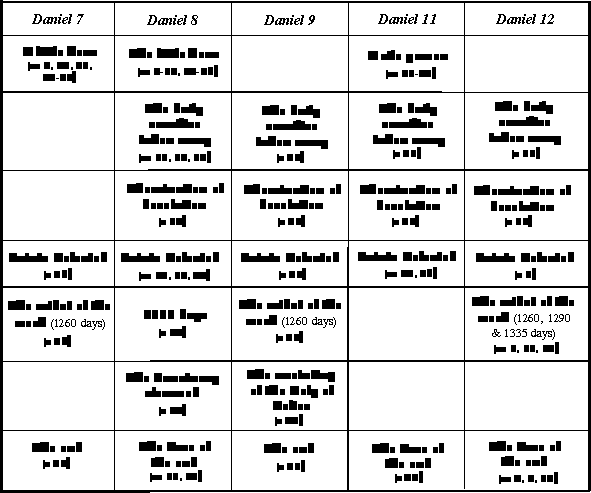
The above chart contains
the major details of Daniel’s visions with regards to the abomination of
desolation. As you examine it you will immediately see that all the visions are
related. God was not showing Daniel a
multitude of different events or personages. He was describing a single period
of time (the end of this present age) and the work of one specific entity (the
"little horn," or Antichrist). He was showing Daniel this endtime
entity, as well as the various events that will surround him, from different
angles and perspectives.
And Jesus went out, and departed from the temple: and his disciples came to him for to shew him the buildings of the temple. And Jesus said unto them, See ye not all these things? verily I say unto you, There shall not be left here one stone upon another, that shall not be thrown down. And as he sat upon the mount of Olives, the disciples came unto him privately, saying, Tell us, when shall these things be? and what shall be the sign of thy coming, and of the end of the world?
Matthew 24:13
After telling the
disciples the temple would be destroyed they asked Jesus, "when shall
these things be? and what shall be the sign of thy coming, and of the end of
the world?" They wanted to know when the temple was going to be destroyed,
and also, when He would return to establish the Kingdom. In answer to their
question the Lord told them many things. One of the things He told them was to
watch for "the abomination of desolation, spoken of by Daniel the
prophet," to be set up "in the holy place" (v. 15).
Every Bible that has a
reference system will have a notation by this phrase, "the abomination of
desolation, spoken of by Daniel the prophet." Those notes will refer you
to three verses in Daniel: 9:27, 11:31 and 12:11. When you turn to Daniel 9:27
and 12:11, your study notes—if you have a Bible with study notes—will explain
that these references to the abomination of desolation are talking about a future
event that is to take place under the reign of the Antichrist. However, when you turn to Daniel 11:31, your study
notes will inform you that this
abomination has already taken place and really has nothing to do with
the one mentioned in chapters 9 and 12.
The notes will explain
that the abomination of desolation in Daniel 11:31 was fulfilled by a Syrian
king named Antiochus Epiphanes in B.C. 168, when his attempt to conquer
Egypt was thwarted by Rome. Infuriated because the Roman Senate had pulled rank
on him and demanded that he cease his wars, he unleashed his fury on the Jewish
people while on his way back to Syria. His soldiers banned all sacrifices at
the temple, as well as all circumcision, and went through the city slaughtering
thousands of men, women and children. Then they desecrated the temple by
putting an idol of Zeus in it, and later, sacrificed a pig on the altar.
Though many commentators
say Antiochus was also a type of the
lastdays Antichrist, they maintain that his actions were the primary
fulfillment of Daniel 11:31. What this means is that there is more than one
"abomination of desolation" being referred to in Daniel’s visions.
One is found in 11:31 and was fulfilled in B.C. 168; the other is found in 9:27
and 12:11 and is yet to be fulfilled by a future Antichrist. Just when you
think you’ve got it all figured out, you learn that the very interpreters who
said the abomination of Daniel 9:27 and 12:11 is a reference to the endtime
Antichrist, can’t decide whether or not these predictions have already been
fulfilled as well. Some of them believe that Jesus’ reference to the
abomination in Daniel pertained only
to the destruction of Jerusalem in A.D. 70. Others believe Him to be referring only to the last part of the Great
Tribulation. Still others see a double
fulfillment in His prediction.
In this latter view, the
abomination (singular) really consists of two desolations: one in A.D.
70 and the other in the last days. When you consider the almost universal
interpretation of Daniel 11:31 as having already been fulfilled by Antiochus
Epiphanes, what you end up with is three
desolations—one in B.C. 168, one in A.D. 70, and one yet to come during the
Great Tribulation. The Believer’s Study Bible explains it this way:
"The terminology "abomination of desolation"
is found in Dan. 9:27; 11:31; 12:11. This text is one of the clearest
examples in Scripture of a prophecy with multiple fulfillment. (1) The
first reference is to Antiochus (IV) Epiphanes, who...halted the sacrifices in
the temple and defiled...[it] by raising up an idol, a pagan altar to Zeus. (2)
Jesus seems to have in view...the near destruction of Jerusalem and the temple
in A.D. 70...(3) Daniel and Jesus, and even Paul, see a future eschatological
and ultimate fulfillment in the actions of the Antichrist during the
Tribulation..."
According to this view,
there are not really three separate abominations being predicted by Daniel.
Rather, there was to be three levels of fulfillment regarding the single desolation he saw. Of course, the
concept of multiple fulfillment is a valid Scriptural principle, but a triple
fulfillment of Daniel’s prediction cannot be supported. In A.D. 31 Jesus
plainly said the abomination
predicted by Daniel was yet future. Unfortunately, the confusion does not stop
here. As you examine more closely the views of various interpreters you
discover that they can’t agree on anything! One example is the following
portion of Daniel’s vision.
And he shall confirm the covenant with many for one week: and in the midst of the week he shall cause the sacrifice and the oblation to cease, and for the overspreading of abominations he shall make it desolate, even until the consummation, and that determined shall be poured upon the desolate.
Daniel 9:27
Many Christians view the
person in this passage as the lastdays Antichrist. But there have been godly
men down through history—like John Wesley, Adam Clark and Matthew Henry—who
believed the one who would confirm the covenant, cause the sacrifice and the
oblation to cease, and make Jerusalem "desolate" was none other than
the Lord Jesus, not Antichrist.1
And out of one of them came forth a little horn, which waxed exceeding great, toward the south, and toward the east, and toward the pleasant land. And it waxed great, even to the host of heaven; and it cast down some of the host and of the stars to the ground, and stamped upon them. Yea, he magnified himself even to the prince of the host, and by him the daily sacrifice was taken away, and the place of his sanctuary was cast down. And an host was given him against the daily sacrifice by reason of transgression, and it cast down the truth to the ground; and it practised, and prospered.
Daniel 8:9-12
The one who takes away
the "daily sacrifice" is specifically identified as the "little
horn" in chapter 8. There can be no mistaking the fact that it is
Antichrist who does this. But this did not affect the view of these men in the
least because in their minds, Daniel
9 was a different vision, dealing with a different character. For them, the
abomination of desolation had nothing to do with an endtime Antichrist. It was
carried out by Jesus in A.D. 70, when He used Titus to fulfil His will in
destroying the city and the temple.
Confusing the work of
Messiah with the work of Antichrist is just one of the problems you encounter
when you separate that which should not be separated. After studying the
different (and opposing) interpretations of prophesy experts, Christian
authors, scholars, commentators and Bible editors, you will probably be totally
confused! Just how many "abominations of desolation" did Daniel see
anyway? Which one was the real one
and who fulfilled (or will fulfil) it?
When ye therefore shall see the abomination of desolation, spoken of by Daniel the prophet, stand in the holy place, (whoso readeth, let him understand:) Then let them which be in Judaea flee into the mountains...For then shall be great tribulation, such as was not since the beginning of the world to this time, no, nor ever shall be. And except those days should be shortened, there should no flesh be saved: but for the elect's sake those days shall be shortened...Immediately after the tribulation of those days shall the sun be darkened, and the moon shall not give her light, and the stars shall fall from heaven, and the powers of the heavens shall be shaken: And then shall appear the sign of the Son of man in heaven: and then shall all the tribes of the earth mourn, and they shall see the Son of man coming in the clouds of heaven with power and great glory.
Matthew 24:15-16; 21-22; 29-30
Although numerous devout
scholars believed the abomination being referred to here is primarily a reference to the then,
sooncoming destruction of the temple and the city of Jerusalem,2
according to the text itself this abomination is clearly linked to the last
days. This should be obvious because: (1) it brings on "great tribulation,
such as was not since the beginning of the world...nor ever shall be"—a
time so bad that if God doesn’t shorten it, "there should no flesh be
saved"—and (2) it culminates with the glorious return of the Lord.
Jesus said,
"Immediately after the tribulation of those days" the sun and the
moon will be darkened, the stars of heaven shall fall, the powers of heaven
shall be shaken, and "then shall appear the sign of the Son of man in
heaven: and then shall all the tribes of the earth mourn, and they shall see
the Son of man coming in the clouds of heaven with power and great glory."
Since none of these events happened "immediately after" the destruction
of Jerusalem in A.D. 70, that desolation could not have been the real abomination of desolation,
"spoken of by Daniel the prophet."
Some have said the
phrase, "there should no flesh be saved," is a reference to the fact
that if God would not have limited the destruction brought about by General
Titus, all Jewish flesh would have
been totally destroyed. But even if it could be proven that Jesus was limiting
this event to the Jews at some future point, the destruction of Jerusalem could
never be construed as that period of time which, for the Jewish people,
"was not since the beginning of the world...nor ever shall be." As
bad as that desolation was, it pales in comparison to what happened to
them during the Nazi Holocaust.
Neither can this view
square with history. In A.D. 70 there were Jews living all over the world. Acts
records that 37 years earlier, during the Feast of Pentecost, Jerusalem was
filled with pilgrims "out of every nation under heaven" (Acts 2:6), a
dozen of which were named (vv. 9-11). Therefore, even if God would not have
halted the massacre in A.D. 70, even if every Jew in the entire Mediterranean
had been killed by Titus, this still could not qualify as the time spoken of by
the Lord in Matthew, for there would have been multitudes of Jews left alive
all over the world. The fact is, if Jesus was talking only about the destruction of Jewish flesh as the
fulfillment of that prediction, Adolph Hitler came much closer to fulfilling it
than Titus ever did because he almost succeeded in killing every Jew in every
nation.
Notice Jesus makes two statements about a group
called "the elect." First, He said if the tribulation weren’t cut
short, no flesh would be saved, "but for the elect's sake" they will
be shortened. All historians agree that just before Titus destroyed Jerusalem,
Jewish believers escaped to Jordan. By the time he took the city "the
elect" were already gone. Why
would God have to cut the time short "for the elect's sake" when
nobody in Jerusalem at the time of the attack was part of the elect? Some say
the term "elect" is a reference to Jews in general, not just saved
Jews, for the Jewish people are said by the Scripture to be an elect race of people, regardless of their
spiritual condition. Therefore, they say, the term elect does not necessarily
have to be restricted to mean only those Jews who were believers.
While the Jewish people
are an elect race, that definition cannot be applied in this particular instance, for the other thing
Jesus said about the "elect" during the time of the desolation
is that there will come "false Christs and false prophets [who] shall shew
great signs and wonders; insomuch that, if it were possible, they shall deceive
the very elect." If it were possible to deceive the elect they would be
deceived, but it is not possible to
deceive them because they will be walking in enough light to see through that
deception. Is it reasonable to view unconverted
Jews who are already deep in deception as "the very elect"—those
closest to Jesus?
Though there was a veiled reference to the coming
destruction of Jerusalem in Jesus’ words, and though certain details of His
answer did have a double application, most of the particulars cannot be made to
fit the events of A.D. 70. God is not the author of confusion. The abomination of
desolation that Jesus referred to, which was spoken of by Daniel the prophet,
was not fulfilled in any degree by
Titus in A.D. 70. There is only one
abomination of desolation and there is only one fulfillment of it. Daniel and
Paul both made reference to the one who is to fulfil it in the last days—the
Antichrist.
And when ye shall see Jerusalem compassed with armies, then know that the desolation thereof is nigh. Then let them which are in Judaea flee to the mountains; and let them which are in the midst of it depart out; and let not them that are in the countries enter thereinto. For these be the days of vengeance, that all things which are written may be fulfilled. But woe unto them that are with child, and to them that give suck, in those days! for there shall be great distress in the land, and wrath upon this people. And they shall fall by the edge of the sword, and shall be led away captive into all nations: and Jerusalem shall be trodden down of the Gentiles, until the times of the Gentiles be fulfilled.
Luke 21:20-24
One reason people get so
confused about Jesus’ reference to the abomination of desolation is because of
how Luke relates the same account in his Gospel. He uses some of the same exact
words as the other two accounts, such as, "...let them which are in Judaea
flee to the mountains..." and "...woe unto them that are with child,
and to them that give suck, in those days," but he specifically refers
these words to the coming destruction of the temple and city. This makes some
assume that the abomination of desolation referred to by Daniel and Jesus
pertained mainly to the destruction of Jerusalem in A.D. 70. Since
the Scripture never contradicts itself, when we come to passages that seem confusing or contradictory we need
to ask the Lord to help us rightly divide His word. The abomination of
desolation referred to by Daniel and Jesus was not a reference to the
destruction of Jerusalem in A.D. 70. How then does what Luke wrote fit?

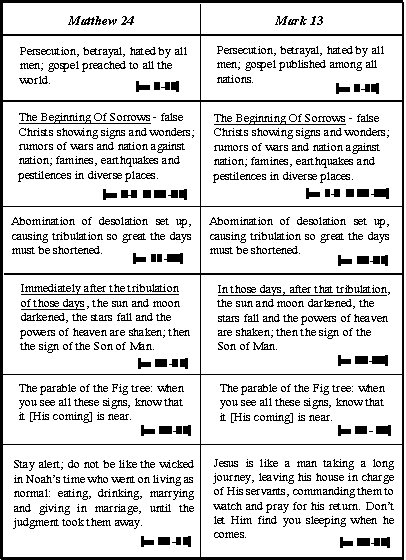
The confusion disappears
when you do a comparative study of all three accounts, for you begin to realize
that they complement each other. Each one supplies different details to create
a fuller picture of what Jesus was saying. The preceding chart contains the
main parts of Jesus’ answer to the disciples’ question, as recorded in the
Gospel of Matthew and Mark, in the order of their fulfillment.3
Although each contains minor details not included in the other account, they
match perfectly. In both of them the Lord gives an overview of the coming
history of the Church from His resurrection to the last days. He describes it
this way: the people of God will be persecuted and betrayed and hated by all
nations. Yet, in the face of all this affliction and rejection they will preach
the gospel in all the world.
Next Jesus begins to
focus on the final days of this age, which He calls the "beginning
of sorrows." This period will be marked by wars and rumors of wars, by
military conflicts between many nations, all going on at the same time, and by
outstanding famines, pestilences and earthquakes all over the earth. It will
also include the appearance of false Christs who possess power so great,
everyone except the "very elect" will be deceived by them. It is during
this period that the "abomination of desolation" is set up in the
temple of God.
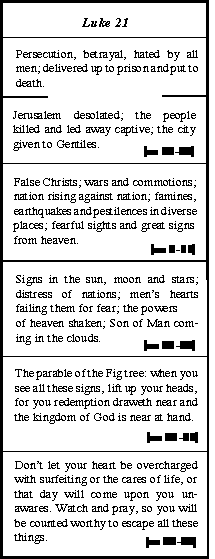 Luke’s
account is basically the same, except that he draws out the secondary
application of Jesus’ words regarding the abomination—the coming destruction of
the temple and the city—and includes
it in the general overview of Church history. He does this in order to warn the
reader of the impending overthrow of the temple and city, encouraging them to
flee when they see the signs come to pass. After this overview, his narrative
moves directly to the beginning of sorrows, then to the heavenly signs which
accompany the Lord’s return, skipping entirely the endtime abomination of
desolation.
Luke’s
account is basically the same, except that he draws out the secondary
application of Jesus’ words regarding the abomination—the coming destruction of
the temple and the city—and includes
it in the general overview of Church history. He does this in order to warn the
reader of the impending overthrow of the temple and city, encouraging them to
flee when they see the signs come to pass. After this overview, his narrative
moves directly to the beginning of sorrows, then to the heavenly signs which
accompany the Lord’s return, skipping entirely the endtime abomination of
desolation.
Thus, the three accounts together furnish a composite answer for
the question the disciples asked Jesus. He told them how to recognize when
Jerusalem was about to be destroyed, also the future history of the Church, and
finally, about the events that will precipitate and surround His literal return
in glory.
There will be only one true abomination of desolation. It was
linked to the events of the last days by Paul and Jesus. Every literal,
historical desolation of Jerusalem was but a type and shadow, a preview of what
is about to happen—yea, is beginning to happen spiritually even now. The Lord
had good reason to warn us to be sober, to be on guard, and to "watch and
pray." He knew our day would be the most
dangerous time in history, even for the most diligent of saints. How much
more dangerous then, is it for those believers who are "sleeping"
spiritually!
When Is Antichrist Revealed?
For the mystery of iniquity doth already work: only he who now letteth will let, until he be taken out of the way. And then shall that Wicked be revealed, whom the Lord shall consume with the spirit of his mouth, and shall destroy with the brightness of his coming:
II. Thessalonians 2:7-8
As was stated, many of
those who interpret the visions of Daniel divide them up arbitrarily and
interpret them according to their own doctrinal presuppositions, many of which
are wrong. Two of these faulty presuppositions are the time at which Antichrist
is revealed and the identity of the one who has been restraining him. The
contemporary view is that the next major event on God’s prophetic calender is
the anymoment secret evacuation. It is assumed that this event will thrust
Antichrist onto the world scene to fill the vacuum of needed leadership after
hundreds of millions of people—many of whom filled critical roles in
society—have vanished. Some pretrib advocates go so far as to say this event is
the only possible phenomenon that
could ever really unite the whole world under the man of sin. Dave Hunt sums
this idea up well in his book, Global Peace And The Rise Of The Antichrist:
"What could possibly bring mankind—even the Muslims,
Jews, Hindus, and Chinese—to this point? The ideal event for effecting
such a dramatic alchemy—and doing it swiftly in one stroke—is the rapture.
In fact, the rapture is the only conceivable event that could cause the
entire world to unite in a new world government and a new world religion and
submit suddenly to the leadership of Antichrist as the world dictator. Here we
have another compelling reason why the rapture must precede the revelation
of the Antichrist and the great tribulation." (p. 204)
He describes what will
happen. Driverless vehicles will careen off roads into homes, public buildings,
pedestrians and each other, causing emergencies everywhere and pileups on
expressways. Pilotless commercial and private planes will fall out of the sky,
killing many people. Conductorless trains will plow into train stations and
into other trains, killing even more people. There will be massive blackouts
and fires will be raging out of control in every city. As the result, police
and rescue workers will be overwhelmed and criminals will be having a heyday.
He says, "...life as we know it would descend into an abyss of chaos and
human carnage. The shock, bewilderment, and stark horror of this historic
global event would paralyze the world." 4
In the midst of all this
upheaval, Antichrist will come to the rescue of the world and put the finishing
touches on the already present oneworld government. Next he will make a treaty
with Israel, bring peace to the whole earth and allow the Jews to rebuild their
temple. Three and a half years later he will claim to be God, move his seat of
power to Jerusalem, do away with the newly reinstated animal sacrifices, put
his own image in the Holy Place (the abomination of desolation), and demand
that the world worship him as God.
Such a scenario is
founded on a variety of erroneous
concepts and reads more like a fairytale than a teaching from the Scripture.
But modernday Christians are not the first to be deceived when it comes to the
events surrounding the Day of the Lord. At the beginning of the Church age,
only a few months after Paul left them, the Thessalonian believers had been
deceived about this Day.
Now we beseech you, brethren, by the coming of our Lord Jesus Christ, and by our gathering together unto him, That ye be not soon shaken in mind, or be troubled, neither by spirit, nor by word, nor by letter as from us, as that the day of Christ is at hand. Let no man deceive you by any means: for that day shall not come, except there come a falling away first, and that man of sin be revealed, the son of perdition; who opposeth and exalteth himself above all that is called God, or that is worshipped; so that he as God sitteth in the temple of God, shewing himself that he is God.
II. Thessalonians 2:1-4
The Thessalonians had
become highly agitated as a result of thinking the Day of the Lord had already begun. Apparently this error
entered the congregation in three ways: through some kind of prophetic
utterance, the source of which was a demon "spirit," by a
"word" (a teaching), and through a "letter" purporting to
be from Paul. Thus, he tells them that certain events must take place before
the Day of the Lord. There must come a great falling away and the man of sin
must be revealed. In order to understand how these brethren could have been
deceived so soon after Paul had been with them, we must understand what he
wrote in his first letter.
But I would not have you to be ignorant, brethren, concerning them which are asleep, that ye sorrow not, even as others which have no hope. For if we believe that Jesus died and rose again, even so them also which sleep in Jesus will God bring with him. For this we say unto you by the word of the Lord, that we which are alive and remain unto the coming of the Lord shall not prevent them which are asleep. For the Lord himself shall descend from heaven with a shout, with the voice of the archangel, and with the trump of God: and the dead in Christ shall rise first: Then we which are alive and remain shall be caught up together with them in the clouds, to meet the Lord in the air: and so shall we ever be with the Lord. Wherefore comfort one another with these words.
I. Thessalonians 4:13-18
Regarding future events,
the Thessalonians were wellversed in some areas and ignorant in others.
Apparently they continued to grieve over their dead as do the unsaved, thus
revealing a need for additional instruction in this area. Paul tells them that
when the Lord returns, all who have died "in Christ" will be
resurrected and all who are alive in Christ will be changed from mortal
to immortality. He also tells them that the living believers who are changed
will have no advantage over those who have died because the dead will rise
first, then together, all will ascend to meet the Lord in the air.
But of the times and the seasons, brethren, ye have no need that I write unto you. For yourselves know perfectly that the day of the Lord so cometh as a thief in the night. For when they shall say, Peace and safety; then sudden destruction cometh upon them, as travail upon a woman with child; and they shall not escape. But ye, brethren, are not in darkness, that that day should overtake you as a thief. Ye are all the children of light, and the children of the day: we are not of the night, nor of darkness. Therefore let us not sleep, as do others; but let us watch and be sober.
I. Thessalonians 5:1-6
Next he touches on the
Day of the Lord, saying they need no further instruction in this area because
they "knew perfectly" that it would come as a "thief" upon
those who are "of the night." Apparently he had already taught them
that when those who are asleep "say peace and safety, then sudden
destruction cometh upon them." The only thing he needed to say to them
about this aspect of that Day was that they should "not sleep, as do
others," but instead, should "watch and be sober" so it doesn’t
take them by surprise.
It is important to
understand the historical and spiritual realities surrounding the confusion of
the Thessalonians. Although they were undergoing persecution from unbelieving
Jews and Romans, the city itself was very prosperous—and this was the height of
the Roman period. Thessalonica had been one of the two most important
commercial centers during the Grecian period; during the Roman period it
functioned as the capital of Macedonia. In other words, it would not be
abnormal for the believers in Thessalonica to view their city, their day and
their situation as the time when
"they" (the children of the night) would be saying "peace and
safety."
The Roman Empire, with
its Caesar claiming to be God and demanding worship, plus the fact that the
area in which they lived was prosperous and secure—people were saying "peace and safety"—plus the fact that they
were suffering intense persecution, could lead some to believe they had already
entered the "great and dreadful day of the Lord." Since they had been
taught to expect deliverance during (not before!) that Day (Is. 60; Hag. 2:67;
Mal. 4:13), they probably viewed Paul’s admonition to watch, pray and stay
awake as a confirmation of their suspicions. They probably thought, "we
must be in the Day of the Lord; we must be that
generation which will be alive and remaining when the Lord returns." From
then on everything seemed to confirm their impression: a false letter in the
name of Paul stating such was the case, a false prophesy from someone in the
group, and a teaching from one of the emerging leaders to that effect. This is
the confusion Paul has to straighten out in his second epistle.
He writes and tells them
that: (1) the Day of the Lord will not begin until there comes a falling away
and the man of sin is revealed, (2) these events cannot happen until the
restrainer is removed, and (3) since the restrainer has not yet been removed
and the Antichrist revealed, they could be sure the Day of the Lord had not yet
begun, regardless of how much their circumstances seemed to point in that
direction, regardless of who was teaching or prophesying otherwise.
Pretrib rapture advocates
try to turn this situation on its head by saying that the Thessalonians were
troubled because they thought they had missed the rapture, thus being left
behind to face the wrath of both Antichrist and God during the Great
Tribulation. The convoluted logic is that if these brethren were expecting to
go through the tribulation and face the Antichrist, then being told they were
already in the Day of the Lord (which includes the tribulation) would not upset
them that much. In fact, it would be a relief to know this because they would
know that their deliverance is very close. Supposedly, the only ones who would
be "shaken in mind" or "troubled" when they found out they
were in the Day of the Lord are those who were assuming they would be taken to
heaven before that Day started.
This logic, though it may
sound right at first, is totally devoid of the historical realties of the
Thessalonian situation. First of all, these brethren didn’t have the
knowledge we do concerning lastdays events. Second Thessalonians was only
Paul’s third epistle, the first two being Galatians and First Thessalonians.
Much of the New Testament—and particularly Revelation, which greatly enhances
our understanding of endtime events—had not even been written yet. The only
thing these believers knew about the events surrounding the Day of the Lord is
what Paul had taught them. They weren’t coming to church twice a week to study
their prophesy charts. Neither were they going from village to village to
listen to Prophesy Club speakers.
In fact, they probably
didn’t have a complete scroll of the Old Testament to read or study; and even
if they did it would not have helped many of them because most of them could
not read or write. All they knew is what Paul had taught them; and though he
did teach them some things about future events, it is evident that he didn’t
give them an exhaustive teaching on
the subject, else he would not have had to write them about the resurrection in
his first letter. Having only a short time with them, he would have focused on
the Person and work of Jesus, what it means to be a disciple, and how to
cultivate a relationship with Him.
Secondly,
they were nothing like wimpy American Christians who are living in luxury and
waiting to be snatched away before any real tribulation makes our lives
uncomfortable. These believers were already
suffering persecution and tribulation. As far as they knew, everything they
were seeing and experiencing pointed towards the fact that they had entered the Day of the Lord. Since
they were taught to expect deliverance in that Day, but it had not yet come,
they were having doubts as to whether God had forgotten them.
Paul said that day will not come until there has
been a great falling away and the man of sin is revealed. Could he have said it
any clearer? Who is the man of sin? Almost everyone agrees the man of sin is
the Antichrist. When is the man of sin "revealed?" On this point
there is disagreement. Referring to Paul’s statement, "then shall that
Wicked be revealed," Charles Ryrie writes, "When Antichrist signs the
covenant with Israel at the beginning of the Tribulation, he will be identified
by some for who he is." 5 But John MacArthur writes, "At the
divinely decreed moment in the middle of the tribulation when God
removes the divine restraint, Satan, who has been promoting the spirit of
lawlessness, is finally allowed to fulfil his desire to imitate God by
indwelling a man who will perform his will as Jesus did God’s." 6
These two views reflect
an even deeper contradiction between two wellknown, staunchly pretrib ministers. The majority of both past and
present pretrib gurus teach that the one who restrains the man of sin is the
ministry of the Holy Spirit through the Church.7 Naturally
then, when the rapture occurs that restraint is removed and he is free to take
center stage and do his thing. However, Mr. MacArthur says the "restraint"
is removed in the middle of the tribulation. In this view, the
restrainer cannot possibly be the ministry of the Spirit through the Church
because the Church has already been gone for 3½ years.
Maybe Mr. MacArthur has
deviated from the standard pretrib party line at this juncture because he has a
sharper mind than most of his contemporaries—at least when it comes to this
point of doctrine—for he understands something that they cannot seem to grasp.
He understands that their view of when
Antichrist is to be revealed, together with their view of when the Day of the Lord begins, equals a denial of what
Paul told the Thessalonians. Most pretrib advocates teach that the Day of the
Lord begins with or immediately after the rapture.
Scofield
said it begins "with the translation of the Church and will terminate with
the cleansing of the heavens and the earth..." 8
Ryrie said it is "an extended period of time, beginning with the
tribulation and including the events of the second coming of Christ and the millennial
kingdom on earth." 9 Pentecost says the Day of the Lord
"is that period of time beginning with Israel after the rapture at the
beginning of the tribulation period and extending through the Second Advent and
the Millennial age."10
Whether the Day of the
Lord begins with the mythical rapture or immediately after it, in both cases
the falling away and the revealing of Antichrist would have to come before this event because Paul said they
must happen before the Day of the Lord, and all pretrib advocates say the Day
of the Lord begins at the rapture. This puts Ryrie in an awkward
position, for he has said Antichrist will be revealed when he "signs the
covenant with Israel at the beginning of the Tribulation." If this is
true, then the man of sin will not actually be revealed until after the Day of the Lord starts, rather
than before it starts—which is a
direct contradiction of Paul’s words.
Moreover, if the one who
restrains Antichrist is the ministry of the Holy Spirit through the Church, as
most teach, then the Church must be "taken out of the way" before the man of sin can be revealed.
Once again, you have a situation where the man of sin is being revealed after the Day of the Lord begins instead
of before it begins—again a direct contradiction of Paul’s words. This
contradiction becomes more evident for those who agree that the Day of the Lord
begins at the rapture, but maintain that Antichrist is not revealed until the
middle of the tribulation. For, then you have the man of sin being revealed 3½
years after the Day of the Lord
begins.
If the Day of the Lord
begins at the rapture, both the falling away and the revealing of Antichrist
must happen before that point—there
is no way around this fact. In order to solve the contradiction a change of doctrinal
position is necessary. Either we must abandon the idea of a rapture at the
beginning of the tribulation, or we must abandon the belief that the Day of the
Lord begins at the rapture. To maintain both positions is to deny the words of
the apostle Paul.
Denying Paul’s words is
what Dave Hunt chose to do. In the Q&A section of his monthly newsletter a
reader questioned him on this very point. His response was: "As for the
Day of the Lord, 2 Thessalonians 2:3 says that the apostasy must come first. It
does not say the Antichrist must be revealed first." 11
The apostasy must come first but not the revelation of Antichrist? Is he
reading the same Bible we are? Let’s read what Paul said again.
King James Version: Let no man deceive you by any means: for that day shall not come, except there come a falling away first, and that man of sin be revealed, the son of perdition...
New American Standard Version: Let no one in any way deceive you, for {it will not come} unless the apostasy comes first, and the man of lawlessness is revealed, the son of destruction...
New International Version: Don't let anyone deceive you in any way, for that day will not come until the rebellion occurs and the man of lawlessness is revealed, the man doomed to destruction...
Today’s English Version: Do not let anyone deceive you in any way. For the Day will not come until the final Rebellion takes place and the Wicked One appears, who is destined to hell.
Mr. Hunt’s denial of
Paul’s clear statement puts him in the same category as those he denounces in
his books for rejecting the obvious meaning of the written Word. Mr.
MacArthur has chosen another course of action. Seeing the fallacy of the
standard pretrib line, he has adjusted
his view to resolve the contradiction by saying the Day of the Lord does not
begin until the end of the
tribulation. This way both the falling away and the revelation of Antichrist
will take place before the Day of the Lord, just like Paul said. He explains it
this way:
"The ‘falling away’ is the abomination of desolation
that takes place at the midpoint of the tribulation...Paul is referring
to the very act of ultimate apostasy which reveals the final Antichrist and sets
the course for the events that usher in the Day of the Lord
12 ...the future ‘Day of the Lord’ which unleashes God’s wrath, falls
into two parts: (1) the end of the 7 year tribulation, and (2) the end
of the Millennium." 13
Of course, this is a
novel view within the pretrib camp. Moreover, it is unlikely to become very
popular because it does more damage to the cause than good. First, it
demands a new interpretation of the pretrib mantra
about "a thief in the night" because it can no longer be applied to
the rapture—it is clearly linked to the Day of the Lord, which, according to
the new view, doesn’t begin until the end
of the tribulation. So he says at the end of the seven years the Day of
the Lord will come upon the unsaved like a thief in the night.
Second,
he has just destroyed one of the main arguments for the necessity of a pretrib rapture—that Christians cannot be here to
experience God’s wrath. If God’s wrath is not to be unleashed until the Day of
the Lord, and the Day of the Lord doesn’t even begin until the end of
the tribulation, why must there be an evacuation at the beginning of the
tribulation? We are leaving the planet seven years before we actually need to.
The fact is, all these preachers and scholars are
walking in total deception regarding the Day of the Lord. They are already under the influence of the man
of sin! He has them waiting for events that will never happen and ignoring
events that are now happening right in front of their faces. He has them
looking for a future human Antichrist while ignoring the current spirit of
Antichrist that is destroying multitudes of believers. He has them preaching
his false doctrines all over the world and he has them bound by spiritual
pride so that they will never be able to receive correction or be shown the
truth.
Paul said the one who is
restraining Antichrist will continue to restrain him "until he be taken
out of the way." Since the Church will be here during the tribulation, the
restrainer cannot be the "ministry" of the Holy Spirit "through
the Church." Quite the opposite; the man of sin is not only turned lose in
spite of the presence of the Church on earth, he begins to seduce the Church along with the world!
The restrainer is God Himself. It has been the Spirit of Truth who has
been holding the man of sin back. All that is necessary for that man to be
revealed is that the Spirit of Truth step out of its way. When the restrainer
steps out of the way we will see certain things come to pass which were
predicted by Daniel the prophet.
And out of one of them came forth a little horn, which waxed exceeding great, toward the south, and toward the east, and toward the pleasant land. And it waxed great, even to the host of heaven; and it cast down some of the host and of the stars to the ground, and stamped upon them. Yea, he magnified himself even to the prince of the host, and by him the daily sacrifice was taken away, and the place of his sanctuary was cast down. And an host was given him against the daily sacrifice by reason of transgression, and it cast down the truth to the ground; and it practised, and prospered.
Daniel 8:8-12
Daniel relates some of
the things the little horn will do when it begins to be manifested in order to
help us identify it: (1) it will cast down some of the host and of the stars to
the ground and stamp on them, (2) it will take away the daily sacrifice, (3) it
will cast down the place of Messiah’s sanctuary, and (4) it will cast down the
truth to the ground. We need to understand that Daniel was describing spiritual realities under the New
Testament. When we view his words in their most literal sense, boxed inside a
strictly Old Testament framework and superimposed on New Testament realities,
we destroy his entire message. He didn’t know many of the concepts of New
Testament Christianity and he didn’t know any New Testament lingo. He certainly
didn’t know any of our modern clichés and expressions. He had to use Old
Testament language and realities to describe what he saw happening to the
people of God in the last days.
Casting down some of the
host, stars and the sanctuary to the ground and stamping on them
is a perfect description of how the little horn is seducing many oncefaithful
brethren in this hour. Through counterfeit supernatural experiences and
revelations, along with their own unconquered pride and lust, he is pulling
them down out of the "heavenly places in Christ" where they were once
"seated" (Eph. 2:6) and trampling
upon them. Casting truth to the ground is a perfect description of the apsotasia, the massive defection from the truth
that we see happening in the Church right now. Taking away the daily sacrifice
is a perfect description of the removal of, or the total perversion of, key
elements of the Christian faith, which makes it void and worthless.
We tried to expose and
explain one of those key elements in the first two parts of this study: the
perversion of the apostolic message of salvation by grace, through faith.
Generally speaking, the gospel that is being proclaimed all over the world in
our day is nothing but an Antichrist counterfeit. It does not save and it
cannot save. Evangelists and preachers "take away the daily
sacrifice" when they make void
the salvation provided by that
sacrifice. They do this when they declare irrelevant or unnecessary the
requirements the Sacrifice Himself laid down for salvation. If Jesus said we
must repent and obey God in order to be saved, all who teach otherwise take
away the sacrifice that He has provided because without repentance and
obedience there is no redemption.
This applies to any
number of key points which, once removed or perverted, makes the gospel void.
There are various ways to take away the daily sacrifice. Many liberal, and even
mainline pastors, deny such fundamental elements of the faith as the virgin
birth, the physical resurrection, or the sinless life of Christ. Tampering with
any of these portions of the gospel message makes it void, for neither a sinful
sacrifice, nor a mere son of Adam who was killed but not raised physically, has
the power to cleanse sin. Such a sacrifice cannot save.
Daniel’s message is to
believers in this hour! He told us that when we see a false Christ deceiving
multitudes of Christians and wrecking havoc in the Church, when we see
Christians casting the truths of the Scripture behind their backs, when we see
Christians following a spirit that is not the Holy Spirit, we should understand
that the Antichrist is being revealed!
Two Spiritual Mysteries
And without controversy great is the mystery of godliness: God was manifest in the flesh...Whereof I am made a minister, according to the dispensation of God which is given to me for you, to fulfil the word of God; even the mystery which hath been hid from ages and from generations, but now is made manifest to his saints: to whom God would make known what is the riches of the glory of this mystery among the Gentiles; which is Christ in you, the hope of glory: whom we preach, warning every man, and teaching every man in all wisdom; that we may present every man perfect in Christ Jesus.
I. Timothy 3:16 & Colossians 1:25-28
Let no man deceive you by any means: for that day shall not come, except there come a falling away first, and that man of sin be revealed, the son of perdition; who opposeth and exalteth himself above all that is called God, or that is worshipped; so that he as God sitteth in the temple of God, shewing himself that he is God...For the mystery of iniquity doth already work: only he who now letteth will let, until he be taken out of the way. And then shall that Wicked be revealed, whom the Lord shall consume with the spirit of his mouth, and shall destroy with the brightness of his coming:
II. Thessalonians 2:34 & 7-8
There are two great
spiritual "mysteries" in operation right now. One is called the
"mystery of Godliness" and the other is called the "mystery of
iniquity." The mystery of Godliness has to do with God being made manifest
in the flesh. The original and supreme revelation of this mystery was, of
course, the Lord Jesus Christ. This is what Paul was referring to in First
Timothy.
But the Scripture teaches
that this mystery did not end with Jesus. Though He is forever the unique individual
expression of God in the flesh, we are to become a corporate expression
of God in the flesh, for we are "His body, the fulness of him that filleth
all in all" (Eph. 1:23). We are called "unto the adoption of
children" (Eph. 1:5). We are called to be "conformed to the image of
his Son, that he might be the firstborn among many brethren" (Rom. 8:29)
who have become "partakers of the divine nature" (II. Pet. 1:4). The
only begotten Son was made perfect "through sufferings" to bring
"many sons unto glory" (Heb. 2:10). He suffered and died in order
that we, though Him, might be called "the sons of God" (I. John 3:1).
Paul describes this
mystery of Godliness as "Christ in you, the hope of glory." It works through the new nature we are given at
our new birth, which he calls a "new man," which is "created in
righteousness and true holiness" (Eph. 4:24). Our new man will never sin
because it cannot sin. It is
uncorrupted and incorruptible. Through it, the Holy Spirit transforms our
character and personality from the fallen image of Adam to the sinless image of
Christ.
The mystery of iniquity
is just the opposite. It has to do with wickedness being manifested in the
flesh. Like God, Satan wants to have his evil nature manifested through man.
Since this mystery works through the
fallen nature we were born with—which Paul calls the "old man" (Eph.
4:24), "the flesh" (Rom. 7:25), and the "carnal mind" (Rom.
8:7)—it could be described as Adam in you, the hopelessness of perdition.
Paul said our Adamic nature "is enmity against God, for it is not subject
to the law of God, neither indeed can be" (Rom. 8:6). In other words, the
"old man" cannot do anything but
sin. Even its most noble attributes and qualities are contaminated with pride
and selfcenteredness—and we have all around us a picture of its ignoble and
baser qualities.
Everyone has at least one
of these mysteries operating in their lives. If we are a believer we have both of them working in us. This is such
a vital truth to understand in this hour that it cannot be overstated or
overemphasized. The vast majority of today’s religious leaders deny that demon
spirits can affect or harm Christians. Such a position is a total denial of
both Scripture and the realities of life. God’s people desperately need to be
taught that He does not automatically remove or render inoperable the mystery
of iniquity after we are regenerated because He can’t. Though the mystery of
iniquity originated in the being and
character of Satan, our "old man" is the vehicle through which
iniquity freely operates and becomes manifest.
As long as we have an old
man the mystery of iniquity will be present, always awaiting an opportunity to
spring into operation. The coldblooded truth is, Satan can and does manifest his nature through
Christians when they walk in the flesh. Just as God is seeking to bring us
under an internal Divine government of perfect obedience so that He—His life
and character—might be fully manifested through us, so likewise, Satan is
seeking to bring us under an internal chaotic government of selfwill and
disobedience so that he might be
manifested through us.
The only way to remove
believers from the influence of the mystery of iniquity is to either change
us spiritually or kill us physically. Of course, physical death
might be a desirable option, compared to what we must endure to be changed from
one image to another, except for the fact that physical death does not alter
our spiritual condition. Those who
die physically without ever being
changed spiritually have only been given a temporary fix. Somewhere, sometime,
somehow, the issue of iniquity will have to be faced again and be dealt with in
a radical way.
The only way to get
completely and eternally free of the mystery of iniquity and all its
consequences is to allow the mystery of Godliness to do its full work in us now, while we are alive.
God has given us the power and the necessary tools to be set free, but we have
to yield to that work; we have to fully cooperate with Him by doing our part.
I beseech you therefore, brethren, by the mercies of God, that ye present your bodies a living sacrifice, holy, acceptable unto God, which is your reasonable service.
Romans 12:1
Paul begged the believers
in Rome to present their "bodies a living sacrifice" to the Lord. He
said such a sacrifice is our "reasonable service" as believers. That
is, it is the only logical course of action considering the great mercies that
have been poured out upon us through the sacrifice of the Lord Jesus Christ.
The term "living sacrifice" is a metaphor taken from the whole
burntoffering under the old Levitical system. In this particular offering,
every part of the animal was consumed in the fire. Thus, the apostle is
exhorting us to give ourselves to God in total
devotion and service. We should view ourselves as wholly His, just as the whole
burntoffering was entirely His. No part of our lives are to be off limits. No
part is to be held back in order to fulfil our own interests and
desires—regardless of whether they be legal or illegal, proper or improper.
The mystery of Godliness
seeks to change our personality. It does this through "death"—Adamic
death. As we stated in the Part Two of this study, one of the most important
principles in Scripture has to do with the relationship between death and life.
We can’t save our life by preserving it. We can only save it by allowing God to
crucify it.
That is why Jesus said,
"...whosoever will save his life shall lose it..." (Matt 16:2425).
That is why Paul said, if we through the Spirit do "mortify the deeds of
the body" we shall live spiritually, but if we "live after the
flesh" we shall die spiritually (Rom. 8:13). That is why he said we must
bear about in our bodies "the dying of the Lord Jesus, that the life also
of Jesus might be made manifest" in us (II. Cor. 4:10). This is why he
said he wanted to know the "fellowship" of the Lord’s sufferings and be made
"conformable" unto his death. He
knew by direct revelation that this is the only way we will ever come to know
the "power of his resurrection" (Phil. 3:10). Out of death comes
life; out of suffering comes strength. There is no other way.
The mystery of iniquity
seeks to keep our personality unchanged. It
does this through "life"—Adamic life. Paul said if we
"live" after the flesh we shall die spiritually. We remain alive when
we refuse to mortify the deeds of the body or bear about in our bodies the
dying of the Lord Jesus. We remain alive when we refuse to experience the
fellowship of His sufferings or allow Him to make us conformable unto His
death. We remain alive when we refuse to stay in places of need or adversity,
or any situation that we cannot control through our own wisdom and strength. We
remain alive when we choose to break out of the various prisons God puts us in
to purge our selfwill. God’s life will never "be made manifest in us"
if we choose to live.
Paul said the mystery of
iniquity would be restrained until the restrainer was taken out of the way. The
restrainer has been restraining this mystery for over 1900 years, yet look at
all the chaos and deception that has taken place in the Church down through the
centuries. If this is what can happen while the mystery is being restrained,
imagine what will happen when the restraint is removed! We have only seen the beginning of horrendous events inside the Church. The chain is off and
the mystery of iniquity is just starting to come to full power.
Believers are in
spiritual trouble today because they do not understand the following realities:
(1) becoming a Christian does not automatically do away with our "old
man," (2) we must allow God to crucify that old man, (3) this crucifixion
is not a onceanddone event, but rather, a process; it must be crucified daily, which is why Paul said, "I die daily" (I. Cor.
15:31), (4) evil spirits can and do
traffic in that old man because they have every legal right to be there, (5)
the little horn or the man of sin is a spirit
as well as an individual, and (6) this Antichrist spirit—or any demon
spirit—can come forth in us just like the Spirit of God can come forth in us.
Just as the nature of Jesus is manifested through our thoughts, words and deeds
as we yield to our "new man," so the nature of Antichrist is
manifested through these things if we continue to yield to our "old
man." All who are ignorant of this reality, all who reject this
reality, do not stand a chance of overcoming the man of sin in this hour.
Paul said Antichrist will
sit "as God" in the "temple" of God. While most Christians
assume he was referring to a man sitting in a literal temple, when you read
what the Scripture actually says, it is clear that such is not necessarily the
case. Remember that he said the Day of the Lord would not come until
"there come a falling away first,
and that man of sin be revealed, the son of perdition who opposeth and exalteth
himself above all that is called God, or that is worshipped; so that he as God
sitteth in the temple of God, shewing himself that he is God." Thus,
he directly connects the revelation of Antichrist with him taking his
seat in the temple. This is both when and how the man of sin is
revealed.
Since almost everyone
assumes the Day of the Lord starts at the beginning of the sevenyear
tribulation period (after the mythological rapture), what this means is that if
Paul was talking about a man sitting in a literal building, then Antichrist
must come to power on the world scene and make a treaty with Israel, allowing
them to rebuild the Temple in Jerusalem. Then at some later point he must take
his seat in that temple, claiming to be God and demanding worship—all before the Tribulation or the Day of the
Lord (or the rapture) even starts!
Incidently, what Paul
said about the falling away and man of sin being revealed before the Day of the
Lord, destroys yet another supposedly indestructible pillar that supports the
pretrib rapture delusion—that of "imminence." All pretrib gurus sing
the same tune when it comes to the doctrine of imminence. Dr. Jack Van Impe,
who has become quite the apologists for the Roman Catholic Harlot these days,
sums it up best. He says, "The return of Christ for His Church is a signless
and alwaysimminent event...[all] signs of the Lord’s return have to do with the
coming of Christ to set up His Kingdom [at the end of the 7year tribulation
period]." 14
The doctrine of imminence
says that no prophetic events must transpire before the anymoment evacuation
can happen. It could have happened any time after the Lord ascended to heaven.
All signs of His coming that are given in the Gospels and throughout the New
Testament pertain only to His coming at the end of the tribulation
period—which in reality is true—except that in the pretrib view, this coming is actually His third coming, not His "second"
coming.
Like the others, Mr. Van
Impe assumes the Day of the Lord starts with the rapture, and that the Great
Tribulation which immediately follows is "a time of wrath." 15 He then quotes Revelation 6:17
("For the great day of his wrath is come") and First Thessalonians
5:9 ("For God has not appointed us to wrath") as proof that the
Church can’t be on earth during the Tribulation because it is "not to be
the recipient of wrath." 16 Thus, he puts himself in the same indefensible
position as the rest of his pretrib comrades. If the Day of the Lord starts
at the rapture, the great falling away and the revelation of the man of
sin—including a rebuilt temple and all the rest of it—must happen before that event. Paul’s teaching shows
that the doctrine of "imminence" is just another Christian myth.
Another piece of the
puzzle that doesn’t fit the pretrib scenario has to do with where the abomination is set up.
Regardless of what we think the abomination is or when we assume it will be set
up, the fact is, we are told very clearly that it will be set up "in the
holy place." Jesus specifically stated this fact. He said, "When ye
therefore shall see the abomination of desolation, spoken of by Daniel the
prophet, stand in the holy place..." (Matt. 24:15). Why would Antichrist
take his seat in the Holy Place and not the Holy of Holies?
Any rebuilt Jewish temple
would follow the pattern of the former temples. A rediscovered or
remanufactured Ark of the Covenant would certainly be placed in the Holy
of Holies to represent the Presence of God, just as in the temples of
Solomon and Herod. It makes no sense that the man of sin, who at that point
claims to be God and takes his seat in the temple to prove it, would choose to
sit in the Holy Place when the God he is trying to replace sits in the Holy of
Holies! Interestingly enough, the old pretrib movie series, "A Thief In
The Night," had Antichrist sitting in the Holy of Holies, which is logical
but totally unscriptural.
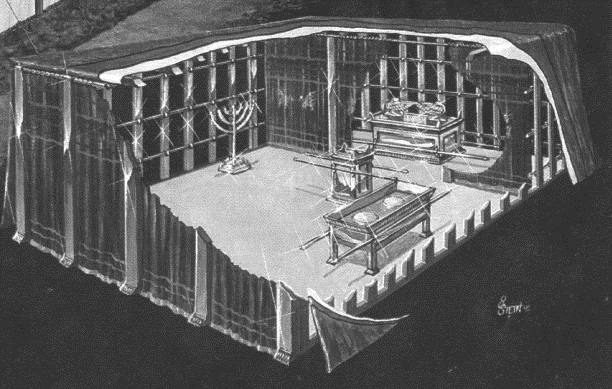
On the other hand, if you
understand that the "temple" to which Paul referred is the people of
God and the man of sin a spirit, it makes much better sense because it answers
precisely to what we see happening all around us. The Old Testament Holy Place
in the Tabernacle represents the
Spiritfilled life of New Testament believers. It represents those who have not
only been bornagain, but who have also been baptized in the Holy Spirit. It represents
moving in the realm of the
supernatural—supernatural gifts, revelation, ministry and power—and this
is ecaxtly where you find the greatest manifestations of the Antichrist
spirit. It is brazenly manifesting itself in Pentecostal and Charismatic circles,
among those who are open to the supernatural.
 The Golden Candlestick, which is the
only source of light inside the Holy Place, represents spiritual power and anointing. It represents spiritual gifts,
ministries and other manifestations of the Holy Spirit. Nothing in this realm
works through the power or wisdom of man (natural light). Once we enter the
Holy Place Realm the Spirit begins to move in and through us in ways we would
never have expected. These manifestations have nothing to do with our natural
wisdom or talents. It is an unseen power who moves through us. Paul said,
"the manifestation of the Spirit is given to every man to profit
withal" (I. Cor. 12:7). It is the Spirit who is being manifested.
The Golden Candlestick, which is the
only source of light inside the Holy Place, represents spiritual power and anointing. It represents spiritual gifts,
ministries and other manifestations of the Holy Spirit. Nothing in this realm
works through the power or wisdom of man (natural light). Once we enter the
Holy Place Realm the Spirit begins to move in and through us in ways we would
never have expected. These manifestations have nothing to do with our natural
wisdom or talents. It is an unseen power who moves through us. Paul said,
"the manifestation of the Spirit is given to every man to profit
withal" (I. Cor. 12:7). It is the Spirit who is being manifested.
 The Table of Shewbread represents our
partaking of the deeper revelations of the Written Word. One of the first
things that often happens to those who are baptized in the Spirit is that the
Scripture begins to open up to them because the Golden Candlestick is shedding supernatural light on the Table
of Shewbread (the Word). We begin to partake of the "hidden manna"
that is contained in the Scripture, but which remains concealed from the carnal
wisdom found in seminaries, Bible colleges and Bible schools. The priests
changed the shewbread weekly, signifying to us that God’s Word and revelation
are always fresh. Not only do they speak to our everyday needs, they are always
unfolding and expanding our capacity to know the Lord.
The Table of Shewbread represents our
partaking of the deeper revelations of the Written Word. One of the first
things that often happens to those who are baptized in the Spirit is that the
Scripture begins to open up to them because the Golden Candlestick is shedding supernatural light on the Table
of Shewbread (the Word). We begin to partake of the "hidden manna"
that is contained in the Scripture, but which remains concealed from the carnal
wisdom found in seminaries, Bible colleges and Bible schools. The priests
changed the shewbread weekly, signifying to us that God’s Word and revelation
are always fresh. Not only do they speak to our everyday needs, they are always
unfolding and expanding our capacity to know the Lord.
The
Golden Altar of Incense represents a life laid down in total surrender
and obedience to God—or as Paul called it— a "living sacrifice." At
this station we experience the "baptism of fire" that John the
Baptist spoke of. It represents judgment on our flesh nature. It represents a
crucified walk—death to self. Just as the incense that was used at this station
had to be beaten and then burned with fire, so we must allow God to purge and
cleanse us by fire
God’s intention has
always been that upon receiving the Baptism of the Spirit, as we experience the
power of the Candlestick and the revelation of the Table of Shewbread, that we
allow the work of the Altar of Incense—which represents crucifixion—to operate
in our lives as well. Not only is a crucified life the only reasonable service
of believers, today it is the only safe
service when we realize that the mystery of iniquity continues to operate
through the old nature, and that the only way to stop it from operating through
that nature is to let God crucify it. It has always been dangerous to allow our
soulish wisdom and talents, or our fleshly desires and lusts, to remain uncrucified when moving in this
supernatural realm. Doing so has gotten many sincere believers into deep
spiritual trouble in the past. But today, when the restraint has been removed
and Antichrist has been granted permission to defile the sanctuary by
duplicating all these things, it is twice as deadly to walk in the Holy Place
Realm uncrucified.
Indeed, those in the
greatest jeopardy are those who are accustomed to seeing manifestations of an unseen spiritual entity, who are used to
receiving guidance through supernatural
means—words, dreams, visions, revelations, visitations, etc.—but who refuse to take
up their daily cross and follow Jesus down the bloody trail of absolute
surrender. All who continue to move in the Holy Place Realm without allowing
the work of the Altar of Incense to operate in their lives are in for a rude
awakening!
And there was given me a reed like unto a rod: and the angel stood, saying, Rise, and measure the temple of God, and the altar, and them that worship therein. But the court which is without the temple leave out, and measure it not; for it is given unto the Gentiles: and the holy city shall they tread under foot forty and two months. And I will give power unto my two witnesses, and they shall prophesy a thousand two hundred and threescore days, clothed in sackcloth.
Revelation 11:1-3
In John’s vision, he is
given a rod to measure the "temple" of God, the "altar"
(Golden Altar of Incense) and "them that worship therein." The
"court which is without" (Outer Court) was not to be measured because
it will be "given unto the Gentiles," who will tread it under foot.
The Outer Court represents believers who are not moving in the Holy Place, who
have not embraced the Baptism of the Holy Spirit. Their being "tread under
foot" is probably a reference to them being killed physically by the beast
government. Thus, they will not be part of what God is doing on the earth at
that point.
It is interesting to note
that when John was given instructions to measure those who are worshiping in
the Inner Court—which is the Holy Place—the only
piece of furniture mentioned was the Golden Altar of Incense. This Altar
was the only piece that was to be measured and the only people who are measured
are those who were worshiping there. Why didn’t the angel tell John to measure
the Golden Lampstand and the Table of Shewbread as well? Why was
he not instructed to measure the believers who were worshiping at these two
stations?
One possible explanation
is that by this point the Golden Lampstand and the Table of Shewbread have been
defiled by the abomination of desolation, and that all who continue to worship
at these stations become defiled as well and have to be set aside from God’s
purposes during this time. The passage inplies
that those who are measured are then sent out as the twowitness company. It
could be that the only ones who are not defiled at this point are those who
allowed God to move them from a life focused on deep revelation, gifts, ministry
and power, to a life focused on crucifixion and on seeking Him alone. It could be that only those who are worshiping at the
Golden Altar will be brought to "the measure of the stature of the
fulness of Christ." One thing is for sure, only those who are presenting
their bodies a "living sacrifice" will be prepared to receive and move in the awesome "power" that
God is going to bestow on this company.
He Taketh Away The First
Above when he said, Sacrifice and offering and burnt offerings and offering for sin thou wouldest not, neither hadst pleasure therein; which are offered by the law. Then said he, Lo, I come to do thy will, O God. He taketh away the first, that he may establish the second.
Hebrews 10:8-9
The writer of Hebrews
laid down an important principle that too few of us who are supposed to be
walking in Third Feast truths are heeding. Because we are not heeding
it, we are struggling to maintain a pure vision and walk in what God is asking
of us. The principle is: "He taketh
away the first, that he may establish the second."
Of course, the context of
this statement deals with the struggle of the Hebrew congregation. They were
not growing (5:12-13) and were drawing back to perdition (10:35-39). The reason
for their spiritual stagnation was that they refused to completely let go of
the old Mosaic System. They had one foot in the New Covenant and one foot in
the Old Covenant. They were mixing
them, trying to walk in both at the same time. The writer quotes Messiah’s
words to let them know that they could not continue to do this. He was warning
them that if they did not plant both feet firmly in the New Covenant, forgetting
those things which are behind, they would end up falling away from the faith
completely.
Right now some are trying
to do the same thing with Second and Third Feast truths. They are trying to
walk in both at the same time. They
can’t completely let go of many of the doctrines, goals and experiences
of Pentecost—things which are not necessarily wrong, but which are simply no
longer the focus of God. Like the Hebrews, they need to be exhorted to plant
both feet firmly in the Third Feast, for if they don’t they will ultimately
miss the mark.
Charity [the nature of God] never faileth: but whether there be prophecies, they shall fail; whether there be tongues, they shall cease; whether there be knowledge, it shall vanish away. For we know in part, and we prophesy in part. But when that which is perfect is come, then that which is in part shall be done away.
I. Corinthians 13:8-10
In discussing gifts and
ministries, Paul frankly stated that this area of experience is an
"inpart" realm. It is only temporary. Though it is of God, it is not
the highest place in God. The highest place is the "perfect" realm.
When that which is perfect has come, then the "inpart" realm or
experience will be disposed of. What needs to be understood is that this whole
gift/ministry realm—which is already described as an inpart realm—is going to
be defiled by Antichrist.
What this means for us
today must be made clear. Whereas, for centuries the only result of focusing on
the things of the inpart realm was that we missed a higher experience in God,
today, because we have entered the time when the abomination of desolation is
being set up in the temple, the result of focusing on the inpart realm is much
worse. Not only do we miss a higher walk in Christ, we could very well end up
in religious delusion!
This is why God is not interested in us seeking
a "ministry" right now—though He does still give us opportunities to
minister. This is why He is not
interested in us seeking spiritual gifts and power (signs and wonders)
at this point—though He does still baptize believers in the Spirit. We must
understand that we have entered a new phase of God’s plan. Things are not the
same as they were 50 years ago and they will never be that way again. Today,
God’s emphasis is on bringing a "firstfruits" company of mature sons
into that perfect realm.
Unfortunately, even
though God’s focus has changed, the focus of most of His people remains the
same—worldevangelism and Church ministry. What is even more tragic is that many
of those who have left the System and acquired a vision of this perfect realm,
even though they teach that we can enter it now,
turn right around and continue to focus most of their walk on the inpart
realm! We need to understand that we must leave
behind the inpart realm if we want to come
into the perfect realm. We cannot keep moving in Pentecost and expect to be
fully established in Tabernacles. It won’t work; and it should be painfully
obvious to at least some of us by now that it isn’t working, for more and more
of those who have embraced Tabernacle truths are being deceived.
The inpart realm is
doomed to be defiled by Antichrist and then discarded entirely by the Lord.
Right now we are seeing the fulfillment of the first stage of this process—God
is allowing Antichrist to enter the Holy Place. As this is happening, the
Father is calling His remnant into the Holy of Holies, behind the Veil.
All who refuse to "enter in" will be deceived. It is not enough to
leave the organized Church. We must leave the spiritual confusion that makes the organized Church what it is. We
must leave the gift/ministry realm because it is filled with mixture and will
only get worse in the coming days as it becomes more and more defiled.
Just like those in the
organized Church, some of those in the "remnant" Church will not move
beyond the place of anointing, beyond the place of gifts and
ministries, beyond the realm of externals, into the life of God. Consequently, not only are they missing the mark, they
are also being deceived, just like those in the System. But though tenthousand
fall, God still has a faithful remnant who are not "camping" around
the Lampstand and Table of Shewbread experiences. He still has people who have
followed the "pillar of cloud" (Ex. 40:36-37) to the Golden Altar of
Incense and are focusing on present truth. God has a people who are remaining
still long enough for the Spirit to purge all selfwill out of their lives.
Even now, God is
preparing His "jewels" for "that day" (Mal. 3:17). This
company of saints are not only called and chosen, but will be found
"faithful" as well (Rev. 17:14). They will not end up in deception. They will not be overcome by Antichrist. They are even now being brought by
the Spirit, "one of a city and two of a family," to the heights of
"Zion" (Jer. 3:14). We may never meet each other before the Day of
the Lord because He is intentionally keeping many of us isolated until
the work has been fully done. But one day soon we will all be revealed together
in glory.
It is not easy to leave
the excitement of Pentecost, for
there is an abundance of fellowship in this feast. It is not easy to leave the activity of Pentecost, for we can easily
find a useful slot in a church, or even start our own ministry, and begin
ministering to the needs of others. It is not easy to leave the enthusiasm of Pentecost, for the
blessing of God is still present and people are involved in all kinds of
worthwhile causes—such as worldevangelism, revival, prison ministry, various
specialized ministries, social reform and political activism—all of which bring
a certain sense of fulfillment.
Walking in Tabernacles is
not all that enjoyable. In order to walk in this feast we have to follow the
Lamb down the same path He walked when He came to earth, which is one of
emotional pain, hardship, selfdenial, persecution, separation, rejection and
loneliness. While others can become famous in the body of Christ through their
talents, abilities and gifts, we must make
ourselves of no reputation (Phil. 2:7). Allowing one’s reputation to be
destroyed among the brethren for the sake of obedience—not because we
are living in sin—is a very difficult thing to do. God will never force this on
us because everything in this walk must be a willing sacrifice.
While others can be on
the run constantly, ministering at every opportunity, we have to learn to keep
our mouths shut, only saying what God wants said and to whom He wants it said.
While others can be in a continual state of motion, blissfully occupied with
the things of the inpart realm, we have to learn to be still, only going where
God allows us to go and when He allows us to go. While God continually blesses
their efforts, even when it is obvious that they are out of His perfect will,
the same is not true for us. In our case, He only blesses that which He
explicitly directs; everything else becomes a disaster. Thus, we have to learn
to minister according to His perfect
will, rather than according to His "good" or "acceptable"
will (Rom. 12:2), or according to our own desire to do good, or our own
religious assessment of the needs of others.
In addition to the
various doctrines, goals and experiences of Pentecost that must be laid down in
order to fully walk in the Feast of Tabernacles, there is the issue of relationships. For some, the question of
relationships—be they with friends, work associates, family members or fellow
believers—is the hardest thing to deal with. For all of us, family
relationships are the trickiest to handle. While we must leave each other free
to follow the leading of the Lord in this area, there are a few general
principles that are clearly laid out in Scripture, some of which are being
ignored because we are not willing to pay this kind of a price to walk in what
God is offering us. In order to help us understand exactly what God is asking
of us and why, we need only look at the life of Abraham.
Abraham’s spiritual
journey was marked by various tests and experiences, but he passed through four notable crises in the area of
relationships, each of which involved a deeper surrender on his part. The first
crises came when God called him to leave his country and his kinsfolk who
"served other gods." (Gen 12:1; Josh. 24:2). As you study the life of
Abraham, it is very interesting to note that the issue of natural relationships
keeps being revisited. His first
major test involved a surrender of family relationships and his last major test involved the same, only
on a deeper level. In between these two tests he had to surrender his
relationship with his nephew Lot, and then his firstborn son, Ishmael.
Of course, the spiritual
principles brought out in these accounts extend beyond the boundaries of mere
family relationships and apply to all
our relationships. Nevertheless, the issue of family does remain a central
focus. This is because family relationships are not a surface issue. They
cannot be taken care of by a onceanddone response. They are issues that keep
coming up, again and again, throughout
our walk. We cannot run away from these issues. Either we will overcome them or
they will overcome us.
Family relationships were
established by God in the Garden of Eden. They were around before the
first city was ever established, before the first house was ever constructed,
before the first job was ever created, before the first field was ever planted
or harvested. Before all the things that we associate with the natural life
even came into existence, there was the family. These relationships are not
evil. However, just because they are Godordained, that does not mean they cannot
become harmful or stand in the way of our spiritual growth.
There resides in every
human being a strong tendency to put family before God. This tendency is deeply
rooted and usually takes years to be purged from our lives. We are just too
fragile emotionally to have a complete work done all at once. Therefore, God
takes us through multiple tests over a long period of time. Like Abraham, there
must come an initial spiritual
separation from family and friends who have chosen to serve the gods of our
culture. This is the first requirement
of all wouldbe overcomers. Unfortunately, many brethren can never get past this
first test. Those who do must not only keep
those relationships on the altar indefinitely, they must go through additional
tests; and with each test comes a call for a deeper level of surrender.
Satan understands the
issues involved much better than we do. He knows our greatest weakness is in
the realm of the emotions and he uses
this to his own advantage. In fact, of all the things that makes Third Feast
believers drop out of the race, by far the biggest one is the refusal to allow
God to deal thoroughly with our natural relationships. Some folks just can’t
make that initial separation. Others can’t maintain
it. Still others who manage to pass the initial separation and maintain it,
nevertheless, can’t go any further. When additional tests come and God calls
for a deeper separation, they can’t pay that price.
Not only do we have to
deal with the pain and misunderstanding of our own family members—as if that
were not enough of a burden to bear—we also have to deal with the humanistic arguments of an unbelieving
world and a blind and deaf Church, both of which tell us that we should
continue to fulfil our family roles in a normal
fashion, regardless of spiritual considerations. In other words, our family
relationships should take precedence over our religion. This universal attitude
emboldens family members to demand
that we continue to fulfil our roles as father, mother, son, daughter, etc., in
a normal fashion. They demand that we never separate from them over any issue.
This is neither the viewpoint of God or His Word; it is the viewpoint of
unsaved men and carnal Christians.
For instance, there was a
man in Israel named Eli, who was the high priest when the Tabernacle of Moses
stood at Shiloh. He had two sons who were priests under him, but who were very
evil, having no regard for the Lord. They were drunks; they slept with the
women who came to the Tabernacle to make offerings to the Lord; and they took
the portion of the sacrifice that belonged to the Lord for themselves. The
people complained to Eli about this wickedness but he did nothing about it. In
fact, he did just what a humanistic world and a blind Church tells us to do—he accepted them unconditionally
and fulfilled his fatherly role in an ordinary fashion, regardless of what they
did. He put his relationship with them before his duty as the high priest.
Finally, God sent a prophet to him to place a curse on him and his entire
family line for all generations.
Speaking for God, this is what the prophet said:
Wherefore kick ye at my sacrifice and at mine offering, which I have commanded in my habitation; and honourest thy sons above me, to make yourselves fat with the chiefest of all the offerings of Israel my people?
I. Samuel 2:29
Putting family before
God, especially wicked family members, is not an issue that the Lord takes
lightly. On another occasion prior to that, Moses blessed the tribes of Israel.
This is what he said concerning the tribe of Levi, who were the priests in
Israel:
About Levi he said: "Your Thummim and Urim belong to the man you favored. You tested him at Massah; you contended with him at the waters of Meribah. He said of his father and mother, 'I have no regard for them.' He did not recognize his brothers or acknowledge his own children, but he watched over your word and guarded your covenant.
NIV Deuteronomy 33:8-9
The reason God chose the tribe of Levi to be priests in Israel was
because they chose God’s name and God’s honor above their own family
relationships. They could be trusted to put Him before everything. Of course,
everyone says they put God before
their family relationships, just like everyone says they are being led by the Spirit. But for some people, what
they say and what they actually live are two very different things.
Many years after Moses
blessed Levi there was a civil war in Israel and the nation was divided into
two separate kingdoms, each having its own king. At one point the king of the Southern
Kingdom (Jehoshaphat) wanted to make peace with the king of the Northern
Kingdom (Ahab). Jehoshaphat was a godly king but Ahab was very wicked. Still,
Jehoshaphat was willing to overlook Ahab’s wickedness in order to "reunite
the family" so to speak. The opportunity came when Ahab was under attack
from a foreign army. He called Jehoshaphat to come and help. Jehoshaphat
agreed, saying, "I am as thou art, my people as thy people, my horses as
thy horses" (I. Kings 22:4). But the Lord was against Ahab because of his
wickedness, and the battle was lost. Ahab was killed and Jehosaphat was almost
killed, but the Lord saved him. While on his way back to Jerusalem, God sent a
prophet to rebuke Jehosaphat. The prophet's name was Jehu.
And Jehu the son of Hanani the seer went out to meet him and said to King Jehoshaphat, "Should you help the wicked and love those who hate the Lord and so {bring} wrath on yourself from the Lord?
II. Chronicles 19:2
Contrary to humanistic
opinion, the Scripture teaches that God expects His people to put Him first. We
are to put Him before all our relationships, whether they be relationships with
friends, work associates or fellow believers. We are to put God before our
spouses, our children and our grandchildren. We are to put God before our own
pleasure, our own goals, our own security, and our own physical safety. We are
to put Him before everything and everyone. God first! This alone is true Christianity—everything else is a
bad joke. Listen to the words of the One who created and established family
relationships to begin with:
For I am come to set a man at variance against his father, and the daughter against her mother, and the daughter in law against her mother in law. And a man's foes shall be they of his own household. He that loveth father or mother more than me is not worthy of me: and he that loveth son or daughter more than me is not worthy of me.
Matthew 10:35-37
In the eyes of the Adamic
man, those who continue to fulfil their family duties (father, mother, son,
daughter, etc.) in a normal way, regardless of spiritual considerations, are
admirable. Those for whom family relationships come first, those who would never allow any thing to divide or separate
them from family, receive the praise of both world and Church and are held up
as rolemodels. But this isn’t the way God sees it. In His eyes, they love their
family more than Him. In His eyes,
they honor their family above Him and
love those who hate Him. In His eyes,
they are not worthy of Him.
Abraham’s second crises
came when he had to surrender his relationship with his nephew, Lot, who was
very special to him for two reasons. First, he was a fellow believer—in today’s
vernacular we would say Lot was a "brother in Christ." In addition,
he was a possible heir to Abraham’s house. The thoroughness of Abraham's
separation from one who, though a brother in Christ and a nephew in the
natural, became a vessel "unto dishonor" by wrong choices is clear.
(See: Gen. 15:13. Cp. Acts 15:36-40; II. Tim. 2:20-21)
Not only must there come
a spiritual separation between us and those who are not serving God at all,
there must come a spiritual separation between us and those who have chosen a lesser walk in God. Lot was not a type
of the unsaved. He is a type of the child of God who chooses a lesser place in
the kingdom. Some of our friends and/or family are not lost; they are believers
in the churches. Because they are brethren we try to maintain a close spiritual
relationship with them. This is a mistake because the Scripture says two cannot
walk together unless they be agreed
(Amos 3:3).
Notice that the issue is
not our attitude towards others. It is not one of love and mercy, or
longsuffering and patience, or forgiveness and tolerance. The issue is walking
together. How can two walk together when they have different goals,
different visions, and are on different paths? When you "walk" in the
Spirit with a person you both have to be on the same path; you both have to be going the same direction; you both have to have the same destination in view.
When we try to
"walk" with those who do not have our vision and are not experiencing
what we are, instead of them coming to a greater understanding of what God is
doing, it is we who end up in confusion! Some of those who are endeavoring to
"walk" in the Feast of Tabernacles are having difficulty keeping a clear vision because they refuse to lay
down their relationships with those who have chosen to "walk" in the
Feast of Pentecost.
If you have been called
to the Third Feast you need to accept an unpleasant reality: you have been
called to a radically different path, experience and destination than your
brethren in Pentecost. They will never
understand what God is requiring of you and you will never, never, never
convince them that sitting around "doing nothing" (that’s how they
view it) is a "higher" walk in God. Furthermore, after a while, you
will begin to feel the same way. You will begin to think, "Wow! look at
all the good they are doing; look at how God is blessing them; look at the
impact they are making; and here I sit doing nothing! Am I really in God’s
will? Is this really what He is asking of me?"
Abraham’s third crises
came when he had to surrender his relationship with his firstborn son, Ishmael.
Now, Ishmael was the result of Abraham wavering in his faith and compromising
with the flesh. He could not endure his "cross" of waiting...and
waiting...and waiting any longer. Ishmael’s birth was an attempt on his part to
fulfil the promise God had made to him, in his time, rather than in God’s own
good time. Those who have embraced a Third Feast walk and experience need to
remain aware of the fact that in many of our situations and relationships there
is a cross for us to bear. Indeed,
much of the exercise of faith consists of patiently submitting to that cross,
allowing it to do its intended work, then waiting on the Lord to remove it.
We are continually
tempted to use our own wisdom, strength and talents to fix the situation that
God has put us in. Through Abraham’s experience, the Spirit of God is teaching
us that if we use our fleshly wisdom and strength to remove the cross (or
crosses) He has placed upon us, there will only be a greater crises to face down the road.
God puts us into various
situations that we despise, situations that bring agony of soul and spirit, but
from which we cannot break free unless we disobey Him. These are prisons. They
are designed to crucify our flesh nature so the nature of Christ can come forth
in us. Whenever we break out of His prison, whenever we lay down the cross that
He has sovereignly placed upon us, we always
go into spiritual deception. The extent of the delusion is determined by
several factors, such as how mature we are spiritually, how long God has been
dealing with us regarding that specific issue, and how bad the rebellion was
that got us out of the prison.
Abraham was growing tired
of bearing the cross God had placed on him. At his weakest moment, Satan moved
through his wife to convince him to break out of that prison. Was Sarah a believer?
Was she walking in the same call and bearing the same cross? The
answer is yes. Does this mean the enemy can use those closest to us, those who are fellow believers, those who are
walking with us in the same call and bearing the same cross, to move us to
disobedience? You bet!
Satan can use anybody to influence and deceive us.
Being a Christian doesn’t mean that we no longer can be deceived or be used to
deceive others. It means that we have the power to no longer be used in that
way, if we avail ourselves of that power. Nothing comes automatically in the
Kingdom of God. If we choose not to avail ourselves of that power, not only
will we be deceived, we will be used to deceive others. What being a
believer means is that we must now be twice as diligent, twice as alert, twice
as watchful, both of our own selves and of those around us, regardless of who
they are.
When he agreed to Sarah’s
plan, Abraham moved in unbelief and rebellion. As a consequence he went into
religious deception. Not only did he deceive himself, not only was he blind to
the reality that this whole effort was doomed because it was the labor of the
flesh and not the product of the Spirit, he walked in that deception for 13
years. Thirteen is the number of rebellion and Abraham was in that
rebellion right up until the moment God shattered the darkness with the light
of the truth that he would father the promised seed through Sarah.
As the truth began to
dispel the delusion and the ramifications of what God was saying began to dawn
on him, Abraham cried, "O that
Ishmael might live before thee!" (Gen. 22:34). In order to understand
the agony behind this cry, we have to realize that for 13 years he had
convinced himself that Ishmael was his true heir. For 13 years he had taught Ishmael
about God and about His promises. He had told the boy that he was the promised
seed and had treated him as the rightful heir to his house. Suddenly, all the
ambitions and dreams he had for Ishmael collapsed before his eyes. He was not
only grieved because of his own rebellion, he was grieved because even though
Ishmael was not responsible for his unbelief, he would have to share in the results
of that unbelief nonetheless.
Abraham was comforted
regarding Ishmael. God said that for his sake He would bless him, make him
fruitful and multiply him exceedingly (Gen. 17:20). Before his birth, God told
his mother he would be "a wild man" (Gen. 16:12) and this is exactly
what he became. He was the progenitor of a hostile desert people which would
eventually carry Joseph to Egypt (Gen. 37:28). Later, they would settle in the
Arabian Peninsula and become known as Arabs—the traditional enemies of the
Jewish people. Mohammed, the founder of Islam, came from this line. Thus,
Ishmael is the father of Islam.
Just how much of Ishmael’s "wild" nature was the result of the frustration and
disappointment he must have experienced after being cast out of his father’s
house like a criminal, is anybody’s guess. But there is no doubt that this
grieving experience had a part in forming both his wild character and his
undying hatred for the Jewish seed. When we break out of the prisons God puts
us in, not only do we hurt ourselves, we can (and many times do) hurt even more
the ones we love most! Just one example out of many that could be provided are
the multitudes of parents who would give anything to go back in time and change
the way they walked before their kids because they realize that their disobedience and rebellion has
been perpetuated through their
children.
Laying Our Isaac down
And it came to pass after these things, that God did tempt Abraham, and said unto him, Abraham: and he said, Behold, here I am. And he said, Take now thy son, thine only son Isaac, whom thou lovest, and get thee into the land of Moriah; and offer him there for a burnt offering upon one of the mountains which I will tell thee of.
Genesis 22:1-2
Abraham’s fourth crises
came when he had to surrender his relationship with his beloved son and true
heir, Isaac. The test with Isaac was much different than the previous tests
because none of the previous ones involved the true seed. None of them involved the actual promise. Of course,
most of us are familiar with the more obvious, traditional lessons contained in
this account.
Isaac is a type of Jesus,
who was "obedient to death" (Phil. 2:58). Abraham was a type of the
Father, who "did not spare his own son..." (Rom. 8:32). Abraham
laying the "wood" of the burnt offering upon Isaac "his
son" and making him carry it up the mountain of Moriah (Gen. 22:6), is a
type of the Father laying the Cross on Jesus’ back and making Him carry it up
the hill of Golgotha. The ram was a type of Jesus’ substitutionary death. He
was offered in our stead (Heb. 10:5-10). Abraham coming down the mountain with
Isaac is a type of the resurrection. The writer of Hebrews states this, saying
that "figuratively speaking, he did receive Isaac back from death"
(Heb. 11:19).
These lessons, while
valid and important, are drawn from the overall view of redemption as seen from
God’s standpoint. But what about Abraham, the man on earth who was asked to
offer up his only son, the promised seed, as a burnt offering? How did he view this whole event? What was
transpiring between himself and God? What did offering up Isaac mean to him?
God’s intention was to see if Abraham loved Him more than he loved Isaac—that
is self evident. But there was more transpiring than simply the surrender of
yet another family relationship. Isaac was more to Abraham than just a son. He
represented the promise God had made
to him.
As for me, behold, my covenant is with thee, and thou shalt be a father of many nations... And I will make thee exceeding fruitful, and I will make nations of thee, and kings shall come out of thee. And I will establish my covenant between me and thee and thy seed after thee in their generations for an everlasting covenant, to be a God unto thee, and to thy seed after thee. And I will give unto thee, and to thy seed after thee, the land wherein thou art a stranger, all the land of Canaan, for an everlasting possession; and I will be their God.
Genesis 17:4-8
Because most of us have
been raised under Dispensationalism—a system of biblical interpretation which
keeps the message of the Old Testament locked inside the framework of Old
Testament realities, instead of interpreting it in the light and revelation of
New Testament realities—we do not understand the promise God made to Abraham in
this passage. What do you see in
those words? Like the Jewish people, most of us view them within a strictly
natural framework. We think the promise given here has only to do with his immediate offspring and a literal promised land.
But listen to how the New Testament defines
the promise given to Abraham in the above passage.
For the promise, that he should be the heir of the world, was not to Abraham, or to his seed, through the law, but through the righteousness of faith...Therefore it is of faith, that it might be by grace; to the end the promise might be sure to all the seed; not to that only which is of the law, but to that also which is of the faith of Abraham; who is the father of us all, (as it is written, I have made thee a father of many nations,) before him whom he believed, even God, who quickeneth the dead, and calleth those things which be not as though they were.
Romans 4:13; 16-17
That the blessing of Abraham might come on the Gentiles through Jesus Christ; that we might receive the promise of the Spirit through faith. Brethren, I speak after the manner of men; Though it be but a man's covenant, yet if it be confirmed, no man disannulleth, or addeth thereto. Now to Abraham and his seed were the promises made. He saith not, And to seeds, as of many; but as of one, and to thy seed, which is Christ...And if ye be Christ's, then are ye Abraham's seed, and heirs according to the promise...Now we, brethren, as Isaac was, are the children of promise.
Galatians 3:14-16 & 29; 4:28
The covenant made by God
with Abraham in Genesis 17:48 referred to much more than just an immediate
offspring and a geographical land. Referring to that covenant, Paul explains the various spiritual realities that
are involved. Within that covenant was the promise that Abraham "should be
the heir of the world." Within that covenant was the reality that the
"seed" of Abraham "is Christ." Within that covenant was the
reality that "...if ye be
Christ's, then are ye Abraham's seed
and heirs according to the promise." Within that covenant was the pledge
that the promise will "come on the Gentiles through Jesus Christ."
Within that covenant was the assurance that "the promise might be sure to all
the seed" and that "we...as Isaac was, are the children of
promise." Within that covenant was the guarantee that "we might
receive the promise of the Spirit through faith."
For all the promises of God in him are yea, and in him Amen, unto the glory of God by us. Now he which stablisheth us with you in Christ, and hath anointed us, is God; who hath also sealed us, and given the earnest of the Spirit in our hearts.
II. Corinthians 1:20-22
For while we are in this tent, we groan and are burdened, because we do not wish to be unclothed but to be clothed with our heavenly dwelling, so that what is mortal may be swallowed up by life. Now it is God who has made us for this very purpose and has given us the Spirit as a deposit, guaranteeing what is to come.
NIV II. Corinthians 5:4-5
In whom ye also trusted, after that ye heard the word of truth, the gospel of your salvation: in whom also after that ye believed, ye were sealed with that holy Spirit of promise, which is the earnest of our inheritance until the redemption of the purchased possession, unto the praise of his glory.
Ephesians 1:13-14
The promises were
spiritual as well as natural. We know that Abraham saw those spiritual aspects
of the promise because the writer of Hebrews said he "looked for a city
which hath foundations, whose builder and maker is God" (Heb. 11:10).
Also, Jesus said, "Your father Abraham rejoiced to see my day: and he saw
it, and was glad" (John 8:56). Nevertheless, even though Abraham’s vision
was not limited to the natural realm,
he longed to have the natural promises fulfilled and Isaac was the first
installment of those natural promises. Through him, Abraham would have an
offspring that would eventually possess a geographical land.
Isaac represented that
which God had given Abraham supernaturally—that
which was given in order to fulfil the rest of the promise. He was not the
complete fulfilment of that promise. Rather, he was merely the first part of the fulfillment of the
promise. Through him the rest of the
promise would be fulfilled. In other words, Isaac was the down payment of the promise.
He was the guarantee note or the earnest of that promise.
For those who are
following the footsteps of Abraham, Isaac represents "the promise of the
Spirit through faith." Not the Spirit in His work of regeneration, but the
Spirit as an "earnest of our inheritance." Isaac is a type of the
Spirit as a "deposit," a guarantee of "what is to come." He
represents those things that God gives us supernaturally—like
power, gifts, ministries, talents, etc.—which are designed to bring us into the
rest of our inheritance. Receiving
the Spirit is not the inheritance. The Spirit is given to reproduce the
fulness of God’s life in our characters: that is the inheritance.
Just as Isaac was not the
totality of the inheritance, but
merely the vehicle through which the inheritance would be attained, so the
"earnest" or "deposit" of our inheritance (the
anointing; gifts and ministries) is not the totality of the inheritance, but
the vehicle through which the inheritance is to be attained. Just as Abraham
had to lay his Isaac down, so we must lay our Isaac down. God does not want us
to remain absorbed with the vehicle. He
doesn’t want Isaac to be the focus.
He doesn’t want the things He gives
us to be our first love. He Himself wants to be our first love.
Feeling a powerful
anointing is enjoyable. Having a powerful anointing on your life is even
better. It gives us pleasure and satisfaction, not only because we enjoy
helping people, but because we enjoy even
more all the attention and glory we get as a result. Everyone wants to be
around the guy who moves in a powerful anointing. Everywhere he goes he is
treated like a king, respected by everyone, and even worshiped. People want to
hear him talk; they want to hear his wisdom and his opinions. He always has
opportunity to minister. Quite frankly, this is one of the biggest reasons
people cannot lay down their gifts and ministries. They may try to act humble
and say, "to God be the glory," but the facts are otherwise. In
reality, they love Isaac and won’t offer him back to God because he brings them glory, honor and satisfaction.
And he said, Lay not thine hand upon the lad, neither do thou any thing unto him: for now I know that thou fearest God, seeing thou hast not withheld thy son, thine only son from me...And said, By myself have I sworn, saith the LORD, for because thou hast done this thing, and hast not withheld thy son, thine only son: That in blessing I will bless thee, and in multiplying I will multiply thy seed as the stars of the heaven, and as the sand which is upon the sea shore; and thy seed shall possess the gate of his enemies; and in thy seed shall all the nations of the earth be blessed; because thou hast obeyed my voice.
Genesis 22:12; 16-18
There are two important
reasons why God is asking people to lay their Isaac down in this hour. The
first one has to do with what we have been discussing: the abomination of
desolation. God has given Antichrist permission to enter the Holy Place Realm
and defile it. This realm is an inpart realm and it is destined to be
completely done away with. But before it is discarded it will be defiled. Right
now, the Holy Place Realm contains both the holy fire of God and the
"wild fire" of Antichrist. All who refuse to move beyond the inpart
realm of spiritual gifts and ministry, beyond the place of anointing, will
eventually end up deceived. If we refuse to refocus our lives on the Golden
Altar of Incense, on crucifixion and death to self, on the inheritance instead
of the vehicle of that inheritance, we will be consumed by Antichrist’s wild
fire.
The second reason has to
do with God finding out if we are capable of handling the inheritance when He
brings us into it. After Abraham had passed his test regarding Isaac, the Lord
said, "now I know that thou fearest God." In other words, now God was
sure Abraham would remain faithful when brought into the full inheritance. Now
God knew Abraham could be trusted because he had proven that the Lord was more
important than anything else in his life.
Likewise, the Lord needs
to know which it is we love most: the
gift or the giver of the gift. He needs to know which it is we desire
most: the promise or the promisor. There is only one way to find out the truth: He asks us to lay down the our
Isaac, our gift. Once we truly yield back to Him that which He has given
us—that which is good, holy and profitable—then
He can bring us into our inheritance, for He will know for a surety that we can
be trusted.
If Abraham would have
held on to Isaac, if he would have clung to the vehicle, he would have
forfeited the inheritance and the same applies to us. We must lay all the
things we have learned and experienced in Pentecost on the altar. If we don’t
we will never attain the inheritance,
for God will never be able to trust us with the power and glory that is
involved in that inheritance. Maybe one of the reasons so few are willing to
pay the price that God is asking of them is because they do not really have a
vision of the awesome things that are involved in that inheritance. Included in
the life of God is the power and authority of God.
Let the saints be joyful in glory: let them sing aloud upon their beds. Let the high praises of God be in their mouth, and a twoedged sword in their hand; To execute vengeance upon the heathen, and punishments upon the people; to bind their kings with chains, and their nobles with fetters of iron; To execute upon them the judgment written: this honour have all his saints. Praise ye the LORD.
Psalms 149:59
And the kingdom and dominion, and the greatness of the kingdom under the whole heaven, shall be given to the people of the saints of the most High, whose kingdom is an everlasting kingdom, and all dominions shall serve and obey him.
Daniel 7:27
Blessed are the meek: for they shall inherit the earth...And every one that hath forsaken houses, or brethren, or sisters, or father, or mother, or wife, or children, or lands, for my name's sake, shall receive an hundredfold, and shall inherit everlasting life.
Matthew 5:5; 19:29
Do ye not know that the saints shall judge the world? and if the world shall be judged by you, are ye unworthy to judge the smallest matters? Know ye not that we shall judge angels? how much more things that pertain to this life?
I. Corinthians 6:23
And Enoch also, the seventh from Adam, prophesied of these, saying, Behold, the Lord cometh with ten thousands of his saints, to execute judgment upon all, and to convince all that are ungodly among them of all their ungodly deeds which they have ungodly committed, and of all their hard speeches which ungodly sinners have spoken against him.
Jude 1:14-15
And he that overcometh, and keepeth my works unto the end, to him will I give power over the nations: and he shall rule them with a rod of iron; as the vessels of a potter shall they be broken to shivers: even as I received of my Father...To him that overcometh will I grant to sit with me in my throne, even as I also overcame, and am set down with my Father in his throne...He that overcometh shall inherit all things; and I will be his God, and he shall be my son.
Revelation 2:26-27; 3:21; 21:7
Do we realize the awesome
power and responsibility that is to be given to the overcomer? The
"kingdom and dominion and the greatness of the kingdom under the whole
heaven" will be given to us. We are chosen to "inherit the
earth" and "all things." We will be given "power over the
nations" and will "rule them with a rod of iron." We will judge both the "world" and
"angels" and will "execute vengeance upon the heathen." We
will "bind their kings with chains and their nobles with fetters of
iron" and "execute upon them the judgment written." We are to
"inherit everlasting life" and sit with Jesus in His
"throne." Do we have any comprehension of what it will mean to sit
in the throne of God with Christ? Most of us cannot even grasp the meaning
of this mindboggling promise!
God cannot afford to give
that kind of power and authority to
people who have not been proven utterly
faithful. We must be put to the test, time and time again, until every single
molecule of selfwill and selfsufficiency has been burned out of us forever. If
we do not love God first, and we are given that kind of power, it will
eventually destroy us. We will become another rebel like Lucifer.
To Be Continued
Notes
NOTE # 1 John Wesley: "He
shall confirm the covenant — Christ confirmed the new covenant,
1. By the testimony of
angels, of John Baptist, of the wise men, of
the saints then living,
of Moses and Elias.
2. By his preaching.
3. By signs and wonders.
4. By his holy life.
5. By his resurrection
and ascension.
6. By his death and blood
shedding.
Shall cause the sacrifice to cease —
All the Jewish rites, and Levitical worship. By his death he abrogated, and put
an end to this laborious service, for ever. And
that determined — That spirit of slumber, which God has determined to pour
on the desolate nation, ‘till the time draws near, when all Israel shall be
saved."
John Wesley’s Notes On The Old Testament
Adam Clarke: [Speaking of the 3 divisions of the 70
weeks shown to Daniel] "To the first period of seven weeks the restoration
and repairing of Jerusalem are referred; and so long were Ezra and Nehemiah
employed in restoring the sacred constitutions and civil establishments of the
Jews, for this work lasted fortynine years after the commission was given by
Artaxerxes. From the above seven weeks the second period of sixtytwo weeks, or
four hundred and thirtyfour years more, commences, at the end of which the
prophecy says, Messiah the Prince should come, that is, seven weeks, or
fortynine years, should be allowed for the restoration of the Jewish state;
from which time till the public entrance of the Messiah on the work of the
ministry should be sixtytwo weeks, or four hundred and thirtyfour years, in all
four hundred and eightythree years.
From the coming of our
Lord, the third period is to be dated, viz., “He shall confirm the covenant
with many for one week,” that is seven years (ver. 27). His confirmation of the
covenant must take in the ministry of John the Baptist with that of our Lord,
comprehending the term of seven years, during the whole of which he might be
well said to confirm or ratify the new covenant with mankind. Our Lord says,
The law was until John; but from his first public preaching the kingdom of God,
or Gospel dispensation, commenced. These seven years, added to the four hundred
and eightythree, complete the four hundred and ninety years, or seventy
prophetic weeks; so that the whole of this prophecy, from the times and
corresponding events, has been fulfilled to the very letter."
Adam Clarke’s Commentary On The Old Testament
Volume 4 ~ Isaiah Through Malachi
Matthew Henry: "...he [Messiah]
must confirm the covenant with many...This covenant he shall confirm by his
doctrine and miracles, by his death and resurrection, by the ordinances of
baptism and the Lord's supper, which are the seals of the New Testament,
assuring us that God is willing to accept us upon gospelterms...He confirmed it
to the many, to the common people...he must [also] cause the sacrifice and
oblation to cease. By offering himself a sacrifice once for all he shall put an
end to all the Levitical sacrifices, shall supersede them and set them aside;
when the substance comes the shadows shall be done away."
Matthew Henry’s Commentary
NOTE # 2 John
Wesley: "...the abomination that maketh desolate...is the standards of
the desolating legions on which they bear the abominable images of their
idols...Not only the temple and the mountain on which it stood, but the whole
city of Jerusalem and several furlongs of land round about it were accounted
holy; particularly the mount on which our Lord now sat, and on which the Romans
afterward planted their ensigns."
John Wesley’s Notes On The New Testament
Adam Clarke: "This abomination of desolation
standing in the holy place refers to the Roman army besieging Jerusalem (See,
Luke 21:20, 21)...[T]his, our Lord says, is what was spoken of by Daniel the
prophet, in the ninth and eleventh chapters of his prophecy; and so let every
one who reads these prophecies understand them. In reference to this very event
they are understood by the rabbins. The Roman army is called an abomination,
for its ensigns and images, which were so to the Jews. Josephus says the Romans
brought their ensigns into the temple, and placed them over against the eastern
gate and sacrificed to them there (War, b. vi. chap. 6,). The Roman army is
therefore fitly called the abomination and the abomination which maketh
desolate, as it was to desolate and lay waste Jerusalem..."
Adam Clarke’s Commentary The New Testament
Volume 5A ~ Matthew Through Luke
Matthew Henry: "Some understand
by this an image or statue, set up in the temple by some of the Roman
governors...Others choose to expound it by the parallel place (Luke 21:20),
when ye shall see Jerusalem compassed with armies. Jerusalem was the holy
city...Mount Moriah, which lay about Jerusalem...was, they thought in a
particular manner holy ground; on the country lying round about Jerusalem the
Roman army was encamped. That was the abomination that made desolate...Now this
is said to be spoken of by Daniel, the prophet, who spoke more plainly of the
Messiah and his kingdom than any of the Old Testament prophets did. He speaks
of an abomination making desolate, which should be set up by Antiochus (Dan.
11:31; 12:11). But this that our Savior refers to, we have in the message that
the angel brought him (Dan. 9:27), of what should come at the end of seventy
weeks, long after the former...Christ refers them to that prophecy of Daniel
that they might see how the ruin of their city and temple was spoken of in the
Old Testament...They might likewise from thence gather the time of it—soon
after the cutting off of Messiah the prince; the sin that procured it—their
rejecting him; and the certainty of it—it is a desolation determined."
Matthew Henry’s Commentary
Charles Spurgeon: "This portion of
our Savior’s words appears to relate solely to the destruction of Jerusalem. As
soon as Christ’s disciples saw "the abomination of desolation," that
is, the Roman ensigns, with their idolatrous emblems, "stand in the holy
place," they knew that the time for them to escape had arrived; and they
did "flee to the mountains." The Christians in Jerusalem and the surrounding
towns and villages "in Judea," availed themselves of the first
opportunity for eluding the Roman armies and fled to the mountain city of
Pella, in Perea, where they were preserved from the general destruction which
overthrew the Jews. There was no time to spare before the final investment of
the guilty city; the man "on the housetop" could "not come down
to take anything out of his house," and the man "in the field"
could not "return back, to take his clothes." They must flee to the
mountains in the greatest haste the moment that they saw "Jerusalem
compassed with armies" (Luke 21:20).
A Popular Exposition To The Gospel According To Matthew
NOTE # 3 In all three accounts—Matt. 24:48; Mark
13:58; Luke 21:8-11—Jesus tells about the beginning of sorrows, which includes
the appearance of false Christs, wars and natural catastrophes. Next He talks
about how believers will be betrayed, persecuted, killed and hated of all
nations. People assume that this time of betrayal and persecution follows
the "beginning of sorrows" because this is the way it appears in
Matthew and Mark. But Luke gives us the proper order of these events.
Matthew: [After His description of the beginning of
sorrows, Jesus says:] Then shall they
deliver you up to be afflicted, and shall kill you: and ye shall be hated of
all nations for my name's sake. And then shall many be offended, and shall
betray one another, and shall hate one another. (24:4-10)
Mark: [After His description of the beginning of
sorrows, Jesus says:] But take heed to
yourselves: for they shall deliver you up to councils; and in the
synagogues ye shall be beaten: and ye shall be brought before rulers and kings
for my sake, for a testimony against them. And the gospel must first be
published among all nations. But when they shall lead you, and deliver you up,
take no thought beforehand what ye shall speak, neither do ye premeditate: but
whatsoever shall be given you in that hour, that speak ye: for it is not ye
that speak, but the Holy Ghost. (13:6-13)
Luke: [After
His description of the beginning of sorrows, Jesus says:] But before all these, they shall lay their hands on you, and
persecute you, delivering you up to the synagogues, and into prisons, being
brought before kings and rulers for my name's sake. And it shall turn to you
for a testimony...And ye shall be betrayed both by parents, and brethren, and
kinsfolks, and friends; and some of you shall they cause to be put to death.
And ye shall be hated of all men for my name's sake. (21:8, 19)
In Matthew’s account the
Lord simply says, "Then shall they deliver you up..." In Mark’s account He says, "But take
heed to yourselves: for they shall deliver you up..." It is left up to the
reader to decide when this time is. But in Luke’s account the Lord discloses the
exact timeframe. He says, "But before all these they shall lay
their hands on you, and persecute you, delivering you up..." Before what
things? Before "many shall come in my name, saying, I am Christ, and shall
deceive many;" before "ye shall hear of wars and rumours of
wars;" before "nation shall rise against nation and kingdom against
kingdom;" before "there shall be famines and pestilences and
earthquakes in divers places;" before "fearful sights and great signs
shall there be from heaven;" before "the beginning of
sorrows." Before all these things come to pass you shall be hated of all
nations, they shall deliver you up to be afflicted and kill you.
According to Luke, the
days of great persecution and worldwide evangelism pertained primarily to the time before the
beginning of sorrows, not after. This is a very important point to understand,
for the only verse in the entire
Bible which explicitly states that the gospel will be "preached in all the
world for a witness unto all nations" is in Matthew 24:14; and Luke tells
us that this will be done before the "beginning of sorrows."
The great emphasis on getting the gospel to all nations "before the
end" is not only a false concept, it is the issue that is uniting all Protestant denominations—many of whom
are completely apostate—with the Roman Catholic Harlot.
People need to realize
that it is this false concept—that we must all put our theological differences
aside so we can work together and get the job of evangelizing the world done in
time—that has completely destroyed the Protestant Reformation; and it is
this false doctrine that will, in the end, get wellintentioned Protestants
killed. For, once Rome regains its full
ecclesiastical/political power in all the nations, she will do the same thing
she has always done: she will use
secular governments to butcher all religious dissenters.
NOTE # 4 Global Peace And The Rise Of The Antichrist,
p.205
NOTE # 5 Ryrie Electronic Study Notes on II. Thess.
2:3 QuickVerse
NOTE # 6 MacArthur Study Bible, p.1855
NOTE # 7 "Wicked as it is, the world is not
quite ready for the Tribulation and the Antichrist. The church is not all it
ought to be, but the world is better because the church is here. Sin is
rampant, but it would be far worse without the presence of the church and its
hindering influence to evil...[The] Holy Spirit, working through Christians,
holds back the tide of evil sweeping the world. When His influence in this
manner is removed at the Rapture, the world will be ready for the Antichrist and
the Tribulation."
Dr. Jack Van Impe
Israel’s Final Holocaust, p.117
"There are various
views as to the identity of the restraining influence. The use of the masculine
pronoun "he" indicates that it is a person. It seems evident that it
is the Holy Spirit: (a) in the O.T. the Holy Spirit acts as a restrainer of
iniquity (Gen 6:3); (b) the restrainer is referred to by the use of both neuter
and masculine genders ("what," v. 6; "he," v. 7), as in
John 14:16-17; 16:12-13 concerning the coming of the Holy Spirit; and (c) it
will be when the restrainer is "taken out of the way" that the man of
sin will be revealed; this will be when the Church is translated and the
Spirit's restraining ministry through it will cease. Observe, however, that it
is not said that the restrainer will be "taken away," but "taken
out of the way"; thus the Holy Spirit will continue a divine activity to
the endtime, though not as a restrainer of evil through the Church."
Quick Verse: Electronic Scofield Study Bible
Notes on II. Thessalonians. 2:3
"The One who is
‘restraining’ is probably a reference to the Holy Spirit in His restraining
ministry through the church. "Restraining" emphasizes what is
presently a strong effort by the Holy Spirit to hold back the maximal
exhibition of evil and the advent of the Antichrist. In the present age the
Spirit is operative in restraining evil. During the Tribulation, the Holy Spirit's
ministry of restraining will be moved out of the way, probably as a result of
the rapture of the church. This is not a departure of the Holy Spirit, for He
is omnipresent, but rather it is a temporary cessation of one of His gracious
ministries."
Quick Verse: Electronic
Believers Study Bible
Notes on II.
Thessalonians. 2:3
NOTE # 8 The New Scofield Reference Bible, p.1372
NOTE # 9 Ryrie Study Bible, p.1808
NOTE # 10
Things To Come, p.229
NOTE # 11
The Berean Call, March 1997; God’s Word: Our Guard and Guide
NOTE # 12
MacArthur Study Bible, p.1854
NOTE # 13
Ibid. p.1849
NOTE # 14
Israel’s Final Holocaust, p.116
NOTE # 15
Ibid., p.117
NOTE # 16
Ibid., p.117